Showing posts with label Library Visits. Show all posts

Monday, 13 April 2015

Our March visit: Pepys, poets and red wine

On the 19th of March, the CLG visited Magdalene College – with three different libraries to look round this was a packed evening and after a glass of wine in the College Parlour we split off into groups to begin the tour.

The lovely Magdalene College wine...
Deputy College Librarian Annie Gleeson took us round Magdalene’s modern, working collection, established as a library in its own right in the 1960s and now housing around 26,000 books aimed at the college’s 340 undergraduates. The working library has grown by extensions over time, and this layout lends the space a cosy feel – rooms follow one after the other, providing students with popular, hidden-away study spaces surrounded by books, some with views out onto the Fellows’ Gardens. 


From the working collection, we moved on to the Old Library, where Deputy Librarian (Pepys Libray and Special Collections) Catherine Sutherland was on hand to tell us about some of the College’s ancient treasures. Magdalene was first founded in 1428, and the collection of the Old Library reflects this long history.

In the Old Library 
The Old Library is particularly strong on 18th century sermons, and also boasts a collection of early printed books, some hand-painted, and a number of medieval manuscripts. Many famous names are associated with books, prints and papers held in the Old Library – T.S. Eliot, Nicholas Ferrar, and George Mallory to name a few. And the collection is not just academic – shelves of buttery books, dating from the mid-17th century, provide an insight into the workings of college life.

College Buttery books in the Old Library
Delightfully retro... collections from the Old Library

The most treasured collection at Magdalene is, of course, the Pepys Library, which came to the Library through the will of the famous diarist. Samuel Pepys died in 1703 and his diary records such iconic events as the outbreak of the plague and the Great Fire of London. Pepys Librarian Dr Jane Hughes talked about just why Pepys’ diary is so important as a resource for social historians; Pepys wrote about all aspects of day to day life – from attending plays to drinking tea. The Pepys Library contains not only his diaries – handwritten in Shelton’s shorthand, and undeciphered until 1819 – but also Pepys’ personal Library, books held in their original bookshelves, and bound in Pepys’ personal binding, bearing his own bookplate with motto – ‘The mind maketh the person.’

The outside of the Pepys Library
As well as a volume of the famous diary, we saw out on display many other treasures testifying to the richness of Pepys’ personal library. A discriminating as well as enthusiastic collector, Pepys ensured his library numbered exactly 3000 books (and Magdalene must maintain this number, neither adding nor taking away, or risk forfeiting the collection to Trinity College...) Among the many beautiful items we saw – which included maritime books, collections of ballads and fragments of medieval manuscripts - a scribe’s model book from c.1410, filled with coloured studies of birds, animals and drapery, was particularly eye-catching, as was the Anthony Roll, open to the only contemporary picture of the doomed ship, the Mary Rose.

Thanks to Annie, Catherine, and Jane for showing us round, and answering our many questions with such enthusiasm!

Contributed by Emily Downes, Faculty of Asian and Middle Eastern Studies Library.

For more information visit the fantastic Magdalene College Libraries Blog  or follow @magdlibs 


Tuesday, 7 May 2013

Visit to the Faculty of Architecture & History of Art

It seems to me that libraries are everywhere in Cambridge, and it never ceases to surprise me when I discover a new one hidden seemingly in plain sight. The Faculty of Architecture and History of Art houses one such library, tucked away in an elegant Victorian terrace just a stone’s throw away from the hustle and bustle of Trumpington Road.

Susanne Jennings provided us with an introduction to the library, which is split into two very distinctive floors. We began our tour on the ground floor of the library, which is very charming and traditional in style, with beautiful original moulded ceilings. Tanya Zhimbiev led us through this floor of the building, pointing out interesting pieces of antique furniture which still see everyday use. Works by local artists are on display in the foyer of the library, connecting the faculty with the wider Cambridge community. We were then shown some wonderful selections from the Maurice Webb Collection of rare books by Matthew Patmore.

The basement of the Faculty of Architecture and History of Art Library is, in contrast, distinctly utilitarian. Designed primarily to maximise storage space, it is remarkable to see just how many shelves have been squeezed into what was once a caretaker’s flat. Every nook and cranny is filled with books, and a small RIBA-maintained library of products, standards and services sits tucked away in a corner.

We were given time at the end of the tour to explore the library and chat amongst ourselves. It was a very enjoyable trip and I very much appreciated the opportunity to discover another of Cambridge’s unique libraries.

YiWen Hon, Graduate Library Trainee at St John's College

Tuesday, 2 October 2012

Visit to the UL Map Department, 21st September 2012

A very dreary, wet Friday evening was brightened up by the first CLG visit of the academic year (and my first trip with the group!). After the wonderful refreshments, we were very kindly introduced to the Map Department of the University Library by Head Librarian, Anne Taylor, and Deputy Head, Andrew Alexander. Andrew gave a masterfully succinct summation of each item in the exhibition, which was very helpful in understanding the breadth of their map collection. The exhibited items themselves ranged from sixteenth century technicolour maps of Cambridge, to aerial maps used as decoys for the enemy in World War Two, to interesting modern map paraphernalia. It was a sheer delight!

My personal favourite was Abraham Ortelius' map, Islandia (ca. 1596), depicting Iceland itself, but also the hazardous beasties that were imagined to live off the coast. Each unusual monster was marked by a letter, which led the reader to an index with descriptions of their fearsome attributes. I was disappointed I didn't get time to read through the entire page!

The Soviet Military map of Cambridge, dating from 1989 (!), was equally fascinating. Areas of industrial or military interest were highlighted, along with vulnerable points, such as bridges. It really demonstrated the importance of mapmaking in a broader context.

Despite the fact that I was an MPhil student in Cambridge and spent half my time in the University Library, I had never dared to enter the Map Department. Now I'll certainly be going back to chart my next holiday!

Thank you to the committee and to Anne and Andrew for a brilliant evening. I look forward to the next CLG event!

By Kirsten Southard, Library Graduate Trainee at Newnham College Library

Sunday, 20 May 2012

Needham Research Institute Visit

A select band of GLG members found their way to Sylvester Road on Friday evening 4th of May, to a hidden and surprising building: the Needham Research Institute. We were greeted by the enthusiastic librarian, John Moffett, who is a graduate of the Chinese Studies Department, Edinburgh University. He has been Librarian of the East Asian History of Science Library at the NRI since September 1992.

John explained that he had been diverted into Chinese studies at Edinburgh because the History lectures were too crowded. After our usual refreshments (including Chinese rice crackers) John gave us an entertaining talk about Joseph Needham and the history of the Institute which bears his name. It was an adventure story, of expeditions into unknown territory, dalliance with attractive young ladies, and a card catalogue of all the people Prof. Needham met in China with their interests and publications all cross referenced. He was assisted by his wife Dorothy (also a biochemist), his Chinese lady friend, and many Chinese scholars in collecting thousands of offprints on subjects scientific, technical, medical and cultural.
On his return to Cambridge, Prof. Needham began to write up his findings, with the CUP willing to publish one volume. This expanded steadily over the years and is so far into its 23rd volume, the work continuing after Joseph Needham’s death.

From the NRI website:
“OVER HALF A CENTURY AGO, Dr. Joseph Needham embarked on a long-term project to investigate the scientific and technical contribution that the Chinese people have made to human culture.

THE NEEDHAM RESEARCH INSTITUTE, which houses the East Asian History of Science Library, is the home of the Science and Civilisation in China project, and welcomes researchers from all over the world with an interest in the history of science, technology and medicine in East Asia.

The library now holds about 30,000 titles, including a number of important collections, and about 20,000 offprints. The library subscribes to a wide selection of journals, many of which are Chinese publications rarely available elsewhere in Europe.

Scholars working in the Institute typically include collaborators on the Science and Civilisation in China project, established academics on sabbatical, doctoral and post-doctoral researchers on one-year fellowships, and other shorter term visitors from around the world. In addition there is a constant stream of academics from the wider Cambridge environment.” 

We had a fascinating glimpse into a world we had hardly heard of, and which is now becoming so much more important with the resurgence of China and all its many manufactures which have entered our homes in recent years.


 By Jillian Wilkinson, Library Assistant at Divinity Library. Photographs by Annie Johnson

Thursday, 19 April 2012

Radzinowicz Criminology Library

Ground floor and stacks by libatcam on Flickr
Located on the Sidgwick site, the Radzinowicz Criminology Library is another one of those Cambridge University collections that you might have heard about but wouldn't normally have the opportunity to visit if you weren't a member of the university. So it was with great interest that I got to see inside this unique library.

I don't know what I really expected but considering that the Radzinowicz has the 'most comprehensive criminology collection in the United Kingdom' with over 60,000 books, I knew it would be substantial. And substantial it certainly is. They have collections that range from modern day social work and prison regulations back hundreds of years to early foundations of law and order. One book I looked at related to the Gaols of Britain in 1766. The entry for Cambridge's County Gaol at Castle Hill states the number of debtors being held, the wage for the jailer and also the cost of the alcohol license he required. It also mentions the gallows in the courtyard, a reminder of this country’s capital punishment that continued right up to 1964.

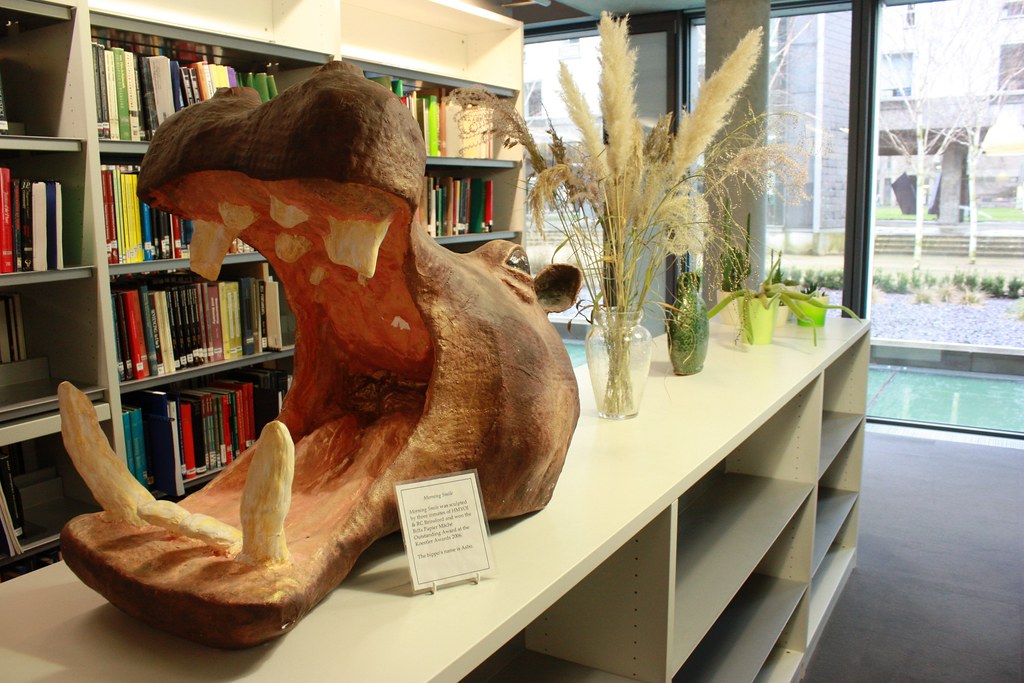
What you might not expect is the large amount of artwork all through the Library created by inmates all over the country. Large numbers of drawings and painting but also some sculptures including an Egyptian bust and a Hippo called Asbo! These lend a very different feel to the library, breaking up the workspace and providing a more vibrant environment but also embedding a wider understanding of those people living by the rules and regulations shelved in the Library.

Morning Smile (Asbo the Hippo) by libatcam on Flickr
We were lucky enough to have two of their more unusual collections laid out for us. The first was a collection of letters and paperwork from the Acid Bath Murderer, John Haigh. This included letters from him to friends before his crimes but also whilst he was in prison, but especially a large number of letters to his parents from people showing their condolences. There is even a Christmas card from one of his future victims.

The second was a selection of Banned Books from the Library’s collection. These books came from the old Home Office in the lead up to the creation of the Justice Department in 2007. The wide selection on display ranged from an 18th century book on flagellation, to guidebooks on Homosexuality and many novels with what would now be considered very tame sexual content. These books were either banned or books that were sent by people to the Home Office in order to get them banned. Unfortunately the number of books taken by the Radzinowicz is a tiny part of what the original collection was comprised of as the majority 'disappeared' but also there is no record of when the books came into the Library, who sent them, were they actually banned and if so when and why. This means it cannot be assessed in a way that we would undoubtedly want to do with such a collection but it is self-evident in places as to the social mind-sets of the time that considered these books outrageous and unsuitability for the public and as such forms a very valuable peek into another side of our past.

By Kevin Symonds, CLG's Secretary, and Library and Information Services Manager at MRC Cognition and Brain Sciences Unit

Wednesday, 16 November 2011

Scott Polar Research Institute Visit

Cambridge Library Group’s own expedition to the Scott Polar Research Institute was a fascinating one. Led by Heather Lane, Librarian and Keeper of Collections, we were treated to a hugely insightful tour of, and talk on, both the museum and library.

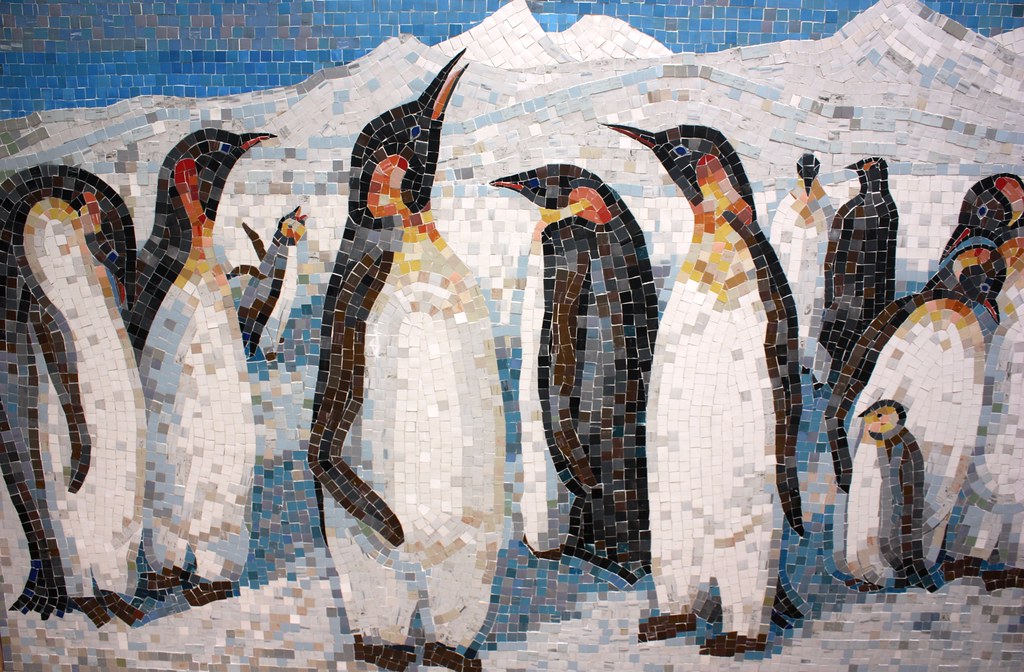
We were firstly shown a tantalising glimpse of the museum in its recently refurbished state; the decoration and white lighting creating a fittingly icy, but also fresh and lively atmosphere. It was lovely to see the original domes of the entrance building, along with its numerous quirky architectural touches such as the polar bear and penguin ceiling decorations (notably along side the North and South domes respectively, proving a handy reminder for anyone unsure of their polar geographical knowledge!) A Roald Amundsen exhibition is currently featuring to celebrate the centenary of his South Pole expedition, whilst preparations are under way for the upcoming centenary of Scott’s Terra Nova expedition. Heather mentioned her dealings already with countless media enquiries surrounding this event, so it looks to be a huge and popular affair.

By libatcam on Flickr
It was particularly encouraging to hear of the museum’s success as a public attraction, especially with children and youth groups, encouraged to use the space in various ways, from theatre performance to artwork. The new and developing interactive services play a role in this too, as do the opportunities for school groups to dress up in clothes and handle example ‘expedition-style’ food (although we didn’t get the chance to do this sadly…) The museum’s smooth running clearly stems from its enthusiastic staff, with volunteers manning the public desk to share their expertise with interested visitors.

En route to the library, I think most of us couldn’t help notice the presence of a bell on the stairs. We soon discovered this to be the very bell from Scott’s Terra Nova, and today it is used (rather wonderfully I think) to ring out twice daily for teatime. Everyone in the institute, we discovered, goes to tea together, allowing a great opportunity for the wealth of information, expertise, and research in the making to unite on a daily basis!

Heather is very keen, and in the midst of securing funding for, the refurbishment of the library and to continue on a large backdating cataloguing programme to replace the current system. Having a modern, fresh library that matches the high level nature of its workings and content is essential. The library is filled with treasures, with many unique Arctic and Antarctic collection and a large picture library. It was interesting to see the unusual classification system, the Universal Decimal Classification for Use in Polar Libraries.

We were finally shown in to the archives - a recently organised space which has undergone quite a remarkable and highly successful transformation from its previous state. Heather revealed it still provides hidden gems, only recently the archivist having discovered another original letter from one of Scott’s expedition group.

This was an invaluably insightful evening, filled with so much information I cannot even begin to do justice to its content. Many, many thanks to Heather. Despite her thoroughness in answering all of our questions, we were all left with one still unanswered, however: how on earth does she find the time for it all?!

By Polly Harper, Library Graduate Trainee at Newnham College Library

By libatcam on Flickr

Thursday, 3 November 2011

Anglesey Abbey Library Visit

Who wouldn't want to have a chance of having a unique view of the library at Anglesey Abbey, one of the local National Trust properties?


By Mark Pettitt on Flickr

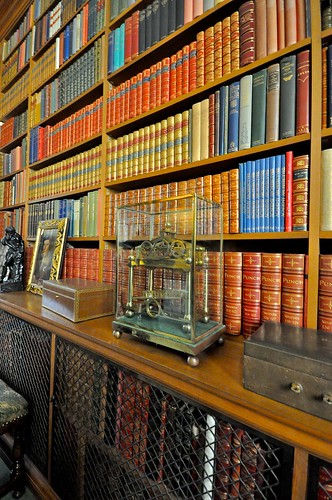
With one of the libraries custodians but also the head National Trust curator Mark Purcell we were shown into the wonderfully packed library where a whole range of books had been laid out for us to see. The books in the library are exceptional both for the high quality of leather bound volumes (such as finest surviving work of the so-called Geometrical Compartment Binder in a copy of the Old Testament) but also because the Library is not made up of the usual medieval manuscripts you would expect the rich to have bought, but contained books bought because Lord Fairhaven liked them. Everything from books on Stalin and Hitler to Alice in Wonderland and especially in subject areas such as horse racing and hunting that he had a particular interest in.

 Not to say that there are not unique and special books as they are very prevalent. A hand painted vellum edition of exotic birds, landscape garden planning with paper overlays, and a catalogue of native American Indians with highly detailed colour plates were on the tables laid out for us to look through. The collection is held in a beautiful room with mirrors at both ends giving an impression of space. And really space is what this collection needs. Although the original configuration of the books when Lord Fairhaven gave it to the NT is not known, both from a NT reorganisation in the 70's and a lack of original records (purchasing details were destroyed by the people in charge at handover - most likely to hide any shady dealings within the accounts) the room is absolutely packed (as is a nearby study) most likely requiring a servant to come in with a ladder when a book was required from a high shelf. There are the usual nice cases that you see in many manor house type libraries where the more unique books are kept, such as the Saxton Atlas, the first English County Atlas book from 1590 that the library holds.

Mark also told us about the breadth of the Windsor collection in the library. Lord Fairhaven grew up on the edge of Windsor Great Park and amassed such a collection of related books that is only surpassed by one other private collection in Windsor itself.

Being able to see the library in such detail was a unique opportunity but the Library itself is part of the public area of the main house and following the new NT's policy of being more open and 'real' there are no ropes holding you back or ruining the impression of how the library used to be and I will certainly visit Anglesey Abbey again to get a view of everything it has to offer.

Mark is in charge of the National Trusts 167 libraries but his knowledge of the Fairhaven collection in Anglesey was shown in his ability to answer all of our questions in his stride and with many interesting stories to fill out the history of the house and of Lord Fairhaven's interests and collecting habits. It will be interesting to see the book about the library that he is currently writing.

By Kevin Symonds, CLG's Secretary, and Library and Information Services Manager at MRC Cognition and Brain Sciences Unit