Showing posts with label Talks. Show all posts

Monday, 13 July 2015

Cycling for Libraries: a fascinating talk about library advocacy on wheels


The Cycling for Libraries project is a library unconference on the move, which visits academic, public and special libraries,  discussing library issues and advocating libraries. 

Our last event in May saw a select group of CLG enthusiasts gather at the MRC Cognition and Brain Sciences Unit (thanks to our secretary Kevin for the very comfortable venue!) to hear Phil Segall of Kingston University, London, talk about his own experience of the Cycling for Libraries unconference. A two-time veteran of the tour, Phil was drawn to the project by his interest in international librarianship, and his talk gave us a great taste of what it was like to take part.

Team spirit – participants on tour. Photo by kind permission of Phil Segall.


In Phil’s first tour in 2013, participants pedalled from Holland to Belgium, braving North Sea cross winds and cycling up to 100 km in a day. We enjoy a snippet of video from day 1 (visit the Cycling for Libraries website to see more videos- they’re great) – there’s something very inspiring about seeing a flood of over 100 librarians and/or library enthusiasts sailing through the streets of Amsterdam. Passion for libraries doesn’t get much more high-vis than this! Stop offs included major university libraries , like the Technische Universiteit Delft and the Ghent Book Tower (Universiteitsbibliotheek Boekentoren Gent), as well as more unusual libraries, such as Affligen Monastery Library, and the Haarlem Stationbibliotheek, one of a developing network of libraries based in railway stations around Holland. Participants were able to make a real push for support for public libraries when they met with Dutch MEPs at the Hague, and members of the European parliament in Brussels, with 214 signing their written declaration calling for recognition of the essential services provided by public libraries. 


Library advocacy – participants at the European Parliament. Photo by kind permission of Phil Segall.

 Phil’s second tour in 2014, organised by Cyclo-Biblio, again put the importance of public library advocacy at the head of its agenda. From Montpellier the participants followed the Rhone to Lyon, ending up at the bilingual World Library and Information Conference in August. In a tour that embraced both rural and urban visits, visits included the Mediatheque Centrale Emile Zola, the University Library at Lyon and (in a side-step from libraries, but one very relevant to the participants) a vineyard and bicycle museum.

One of Phil’s many great tour photos shows a participant collapsed in (triumphant) exhaustion, but it’s clear the physical challenge is offset by the fun of seeing so many and so varied a collection of libraries, from mobile libraries to museum libraries, and by the brilliant learning opportunities provided along the way. It’s fascinating to see how in Holland (where many public libraries are not free of charge for adults) libraries are pushing their services through bold advertising – if only UK libraries had such a great billboard presence – and trying to bring books to the public by setting up libraries where there’s a ready audience – not only in train stations but even at Amsterdam airport. Seeing how different libraries use their data and manage their services is a great source of inspiration.

  
 Where can a chicken find out about her eggs…? Eye-catching library advertising from Holland. Photo by kind permission of Phil Segall.

 As Phil has shown us, an unconference on wheels - simultaneously an advocacy drive, a learning experience and a leisure trip – might have its fair share of challenges (the video of the intrepid cyclists crossing a main junction in France is, frankly, a little daunting – luckily road captains are on hand to halt the traffic!), but from what we saw in this great presentation, the rewards are more than worth the effort.

Contributed by Emily Downes, Faculty of Asian and Middle Eastern Studies Library.

Visit the project's website here: http://www.cyclingforlibraries.org/

Friday, 17 April 2015

Coming Soon! Cycling for libraries: a talk by Phil Segall


We're very excited to be joined on 6th May by Phil Segall (@LibraryBod), who will give a talk about the Cycling for libraries project - library unconferences on the move, which visit academic, public and special libraries,  discussing library issues and advocating libraries. 

This year the theme is New Nordic and the tour will go from the fjords of Oslo in Norway, along the west coast of Sweden before arriving in Aarhus, Denmark.  Intrigued? Join us to find out more.  The talk will take place at the  MRC Cognition and Brain Sciences Unit, 
15 Chaucer Road - a stone's throw from the Botantic Gardens. Stay tuned for more information!


Wednesday, 18 February 2015

Storytelling and selkies with Gillian McClure

Korean Sketch Book. Image reproduced by kind permission of Gillian McClure.

On Wednesday 11th February, the Cambridge Library Group hosted a presentation by children’s author and illustrator Gillian McClure.  Gillian’s presentation entertainingly explored the many different facets of creating a picture book – from the initial inspiration, to the evolution of the idea, and then the capturing of the characters, energy and emotion of the tale through illustration, text, and typography.  This journey through Gillian’s creative process was accompanied throughout with illustrations from her works, conveying her creative range and celebrating the evocative nature of visual storytelling.

It was fascinating to hear about the creative process involved in formulating a character and a story.  Sometimes a story could begin with a simple image – like a hen nesting in the tail of a fox (Flood, 2014) or a line of sticks in the sand (Selkie, 2010).  Sometimes a story could begin with a friend recounting the antics of a kleptomaniac cat (Tom Finger, 2002), or from sketches of a South Korean village seemingly untouched by time (The Land of the Dragon King, 2008).  In each instance Gillian stressed the value of an organic approach to writing, and the importance of finding a personal connection with the story’s setting. Trying to pin down a story onto paper too soon can stunt its growth.  A story cannot be forced, but rather formed by countless experiences, images and encounters.  An unexpected remark from a stranger whilst waiting in a queue at the fish van, for example, took the story of Selkie in an entirely unexpected direction, ending up in a setting deeply rooted in memories of holidays in Colonsay and Orinsay. 

 Tommy Finger 'dummy', pages 6-7.  Image reproduced by kind permission of Gillian McClure.

Picture book story telling is a complex and diverse art form and part of Gillian McClure’s appeal is the stylistic variety of her work.  Gillian’s most recent book, Flood, is highly suitable for early years with large earthy images, sparing language and a simple story.  This contrasts sharply with Tog the Ribber (1985) a collaboration with her father, Paul Coltman.  Coltman’s frightening story, Jabberwocky-like word play, and fast-paced rhythm are complemented by darkly detailed illustrations that gradually break through the borders on the page as we reach the climax, undermining any former illusion of safety and containment.  This book is certainly more appropriate for older readers and it is no wonder it was highly commended in the Kate Greenaway awards, 1985.  Different again are works like Zoe’s Boat (2012) and We’re Going to Build a Dam (2013).  The former provides a great example of the use of graphic novel frames to capture a fast paced, action-packed story; the latter demonstrates the interdependence of illustration and typography, showing how playful use of type can enhance the narrative. Gillian works very closely with typographical designer Lisa Kirkham from an early stage to achieve this. It is also important to read the words aloud as you’re writing to hear how they sound. Words lie flat on the page until the tune or tone of the story is captured and the words spring to life.

This was a fun and fascinating event that also included a display of Gillian McClure’s art and an opportunity to buy some of her books.  We are both now in possession of signed copies of Flood (Jodie for her three year old niece, Annie for herself) and Jodie fully intends to hunt out a copy of Tog the Ripper. Picture books aren’t just for kids, you know.


Colonsay sketch. Image reproduced by kind permission of Gillian McClure.
Contributed by Jodie Walker, Librarian at Peterhouse College, and Annie Gleeson, Deputy Librarian at Magdalene College.

For more information about Gillian's work see her website and blog:
www.gillianmcclure.blogspot.com 

Tuesday, 16 September 2014

CLG & CILIP East joint event - Clare McKenzie (International Librarians Network)


We have an exciting event coming up in October! Cambridge Library Group and CILIP East of England are hosting a talk by Clare McKenzie, one of the founders of the International Librarians Network.

This free event will be on Tuesday 21st October 2014 at the Law Faculty (room B16), Cambridge. There will be drinks and nibbles available from 5.30pm, and the talk will begin at 6pm.

The International Librarians Network is a global peer mentoring programme which helps librarians to develop their networks beyond the borders of their home countries. Join us on 21st October to learn more about this programme and how you can get involved!

Tuesday, 15 April 2014

Gwen Raverat talk by Frances Spalding - 3rd April 2014

A few weeks ago CLG met for a lively talk by art historian and Newnham College alumna Frances Spalding on the subject of the artist Gwen Raverat.


We were fortunate enough to be able to use the Old Library at Darwin College as our venue, highly appropriate as it was once the front room of Gwen Raverat's family home, then called Newnham Grange. Primarily known for her wood engravings, Gwen was also an illustrator, painter, author and journalist. Frances illustrated her talk with quotes from Raverat's autobiography Period Piece: A Cambridge Childhood. These charming, and often very funny snippets took us back to the late nineteenth century, when as Gwen wrote, "nearly all the life of Cambridge poured back and forth over the bridge outside our house". One of my favourite anecdotes was of Gwen's eccentric aunt Etty, who was a bit of a hypochondriac and fashioned her own anti-germ mask out of a tea-strainer stuffed with antiseptic-soaked cotton wool, which she wore over her mouth and nose!

As a member of the very tight-knit Darwin clan, the presence of her grandfather Charles Darwin was there throughout Gwen's life, despite Charles having died three years before she was born. The Darwin family were often viewed by others with some scepticism, which perhaps led to the tighter-than-normal family bond.

Gwen taught herself the art of wood-engraving while at the Slade School in London, where she also met her husband Jacques Raverat, who had been a mathematician until doctors advised him to give up mathematics for his health, and take up art instead! Sadly, Jacques' health continued to deteriorate, and he was eventually diagnosed with multiple sclerosis. The Raverats decided to move to France in the hopes that the warmer climate would help. While in France, they continued to keep in touch with friends at home, in particular with Virginia Woolf, who wrote to Jacques often and kept him up-to-date with news and gossip.

After Jacques died in 1925, Gwen decided to return to Cambridgeshire, and in her final years was often seen sitting by the Backs in her wheelchair, painting.

I knew very little about Gwen Raverat before hearing Frances' talk, and I found the evening thoroughly enjoyable. As always it was great to catch up with other librarians, and Period Piece is now next on my 'to-read' list!

By Annie Gleeson, Senior Library Assistant at Homerton College

Monday, 10 March 2014

Talk by James Campbell, 12th February 2014

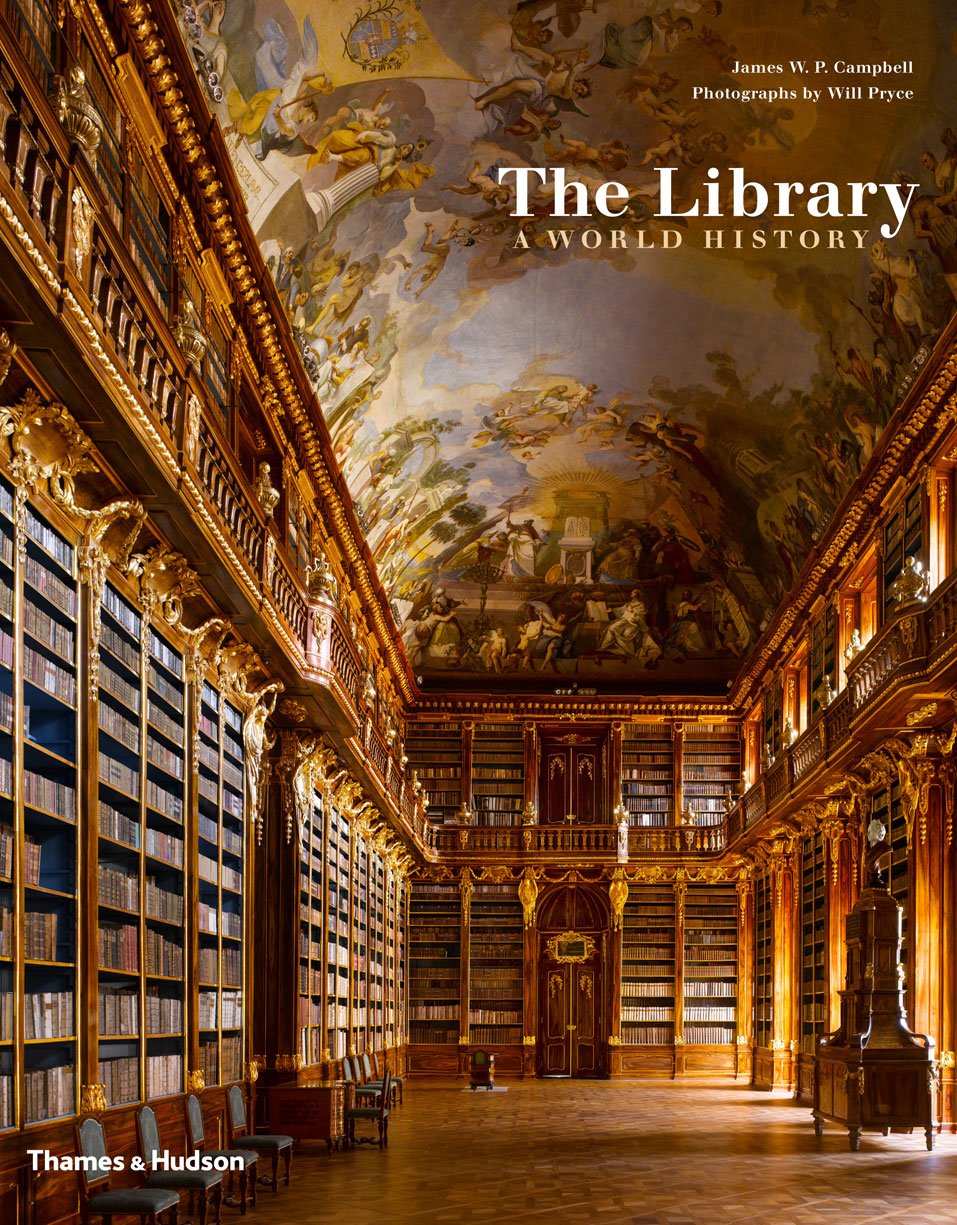
Our February CLG event was a talk about the history of library architecture, by the author of The Library: A World History, James Campbell. He gave us a quick overview of everything, a whistle-stop tour of significant libraries from around the world, accompanied by some stunning slides.

Apparently libraries were originally used merely to house scrolls or books, and instead of studying within the library you would come and take away the item to needed to peruse elsewhere. This impacted on the architecture as there was no need to plan for people to actually use it. James also said that there’s a possibility Greek and Latin libraries might have purposefully been built together, to complement each other when those languages were both vitally important for education. He took us everywhere from a monastery in South Korea, where a huge library houses just one book and its corresponding printing blocks, to Michelangelo’s Medici Library (which is beautiful but apparently not practical at all!), to the Biblioteque Nationale and the National Library of Beijing, shining examples of modern library architecture. We saw libraries change from repositories to interactive study-spaces, and the rise of the public library from the 19th century onwards. From 16th-century stalls to (apparently James’ favourite) 18th-century Rococo designs and 19th-century barrel-vaults, the library has always adapted to the architecture of the time in new and surprising ways, including hidden doors and libraries completely made from iron!


It was a really interesting lecture and made me want to go travelling just to see libraries around the world. Talk about your busman’s holiday…! There really are some amazing library buildings out there. I’m also definitely going to be buying his book, if only to give me something to aim at for future holidays!

By Lucy Woolhouse, Graduate Trainee Librarian at Christ's College.

Thursday, 27 June 2013

Talk by Michelle Spring, 18th June 2013

Last week CLG members gathered at the English Faculty for a talk by the author Michelle Spring. Michelle's topic was 'What does a writer do when she's not writing? Teaching, mentoring and the Royal Literary Fund'.

After working as a professor of Sociology at Anglia Ruskin and Cambridge University, Michelle turned her hand to writing crime fiction. However she was able to combine her new career with her passion for teaching by becoming a Royal Literary Fund Fellow. The RLF Fellowship scheme places writers in Higher Education institutions, to support students and staff in their writing. Currently there are three partner institutions in Cambridge - Anglia Ruskin University, Newnham College and Magdelene College, and Michelle has worked in all three of these institutions as an RLF Fellow.

The RLF Fellowship scheme provides students with the opportunity for confidential one-to-one sessions on any aspect of writing they are having difficulties with, ranging from correct use of a semicolon to turning a dissertation into a publishable article. This kind of support is not always available from supervisors and tutors, and can make a big difference.

Michelle also talked about her experiences teaching creative writing courses and mentoring less experienced authors. While creative writing courses are excellent at providing a support network and making new authors get writing and keep on writing, mentoring develops a stronger, long-lasting relationship which can be very rewarding for both the mentee and the mentor.

Michelle with some CLG members
I thoroughly enjoyed this event. Michelle was an engaging and down-to-earth speaker, and I think many of us were inspired to find new ways to support our students with their writing, or indeed to pick up the pen ourselves! Michelle had brought along a list of recommended books on writing, which I have copied below:

Elizabeth Benedict, The Joy of Writing Sex: A Guide for Fiction Writers
Dorothea Brande, Becoming a Writer
John Gardner, The Art of Fiction: Notes on Craft for Young Writers
Stephen King, On Writing: A Memoir of the Craft
Anne Lamott, Bird by Bird: Instructions on Writing and Life
David Lodge, The Art of Fiction, Illustrated from Classic and Modern Texts
Michelle Spring and Laurie R. King, Crime and Thriller Writing: A Writers' and Artists' Companion
William Strunk, Jr. & E. B. White, The Elements of Style

Reference for writers:
Writers' and Artists' Yearbook
Collins Easy Learning Grammar and Punctuation
The Merriam-Webster Dictionary of Synonyms and Antonyms

Michelle Spring's novels:
Every Breath You Take
Running for Shelter
Standing in the Shadows
Nights in White Satin
In the Midnight Hour
The Night Lawyer 
   

Wednesday, 15 May 2013

Samuel Butler Project - Presentation by Rebecca Watts, Butler Project Associate


Samuel Butler - Victorian polymath (1835-1902)
In the fleur-de-lis decorated Lightfoot Room CLG members gathered for a very illuminating presentation on the Victorian polymath Samuel Butler (1835-1902). Butler was a writer, artist and photographer. He engaged in ‘written debates’ with Darwin and was respected by significant contemporaries such as George Bernard Shaw and E. M. Forster. Butler wrote fiction and non-fiction, subjects include evolution, art, religion and travel. He often provided illustrations for his own works. His photographic works reflect his travel in Italy and provide a social history of Victorian society.

The Butler Collection includes around 100 boxes of papers, articles and correspondence, more than 650 printed books, 450 paintings, watercolours, drawings and prints, 50 artefacts and a substantial photographic archive.
Selection of Samuel Butler's paintings and sketches

Rebecca also provided an insight into managing such a diverse archive, including deciding which items should be conserved, creating a searchable catalogue, organising events and exhibitions, working with schools and putting Butler scholars in contact with one another.

The Butler Project began in July 2011 and runs until July 2013. The project is funded jointly by the Heritage Lottery Fund and St John’s College. For further information visit http://www.joh.cam.ac.uk/samuel-butler-project.
Rebecca Watts (Butler Project Associate) and Rachel Walker (Temporary Library Projects Assistant)
By Jo Milton, Collection Development Manager at Cambridge University Medical Library

Tuesday, 7 May 2013

Special Collections Lecture - 'The Uses of Scientific Heritage: The Collections of the Royal Institution'

CLG members may be interested in the upcoming Emmanuel College Library Special Collections Lecture on 6th June.

Speaker: Professor Frank James, Head of Collections and Heritage, Professor of History of Science, at the Royal Institution

'The Uses of Scientific Heritage: The Collections of the Royal Institution' 

The Royal Institution possesses a remarkable heritage in terms of manuscripts, objects and images going back to its foundation in 1799. These relate not only to institutional history but to those who have researched, lectured and lived in its Mayfair building. Those who figure prominently in the institution's heritage include Humphry Davy, Michael Faraday, John Tyndall, James Dewar, William Bragg, Lawrence Bragg and more recently George Porter, all of whose papers are held in the collections. Significant objects in the collections include the first miners' safety lamp, the first electrical transformer and generator, the first thermos flask and so on. This talk will discuss the issues surrounding managing this diverse collection and how it can be used to illustrate the development of science over the past two centuries or so, as well as conveying contemporary messages about the role of science in society and culture. 
Date: Thursday 6th June 2013
Time: 14:15
Venue: The Laing Centre, Atrium, Emmanuel College Library 

Numbers are limited. Booking is essential and entry will be by free ticket only. Please book early by either e-mailing the College Library at library@emma.cam.ac.uk or telephone (01223) (3)34233. A ticket will be sent to you on receipt of booking.

Tuesday, 5 March 2013

Cambridge Publishing Society event - Open Access academic publishing

Tonight at Anglia Ruskin University there is an event on Open Access academic publishing, organised by CAMPUS (Cambridge Publishing Society), which may be of interest to our members.

Time: Today, 5th March 2013 at 6pm - 8:15pm
Location: Harvard Room LAB 109, Anglia Ruskin University, East Road, Cambridge CB1 1BD

For more details, please see the CAMPUS website.


Monday, 26 November 2012

Visit to Cambridge University Press Museum

On Thursday 8th November, members of the Library Group headed to Cambridge University Press to learn about and view the recently opened Museum within the Press’ vast Edinburgh Building. The space is not usually open to the public, so the opportunity to visit was a real treat. The evening began with some much enjoyed tea and biscuits, kindly provided by the Press. Once these were consumed, we were led through the Press’ labyrinth of corridors towards the Museum. The space that greeted us was inviting and attractive; its layout, furnishing and lighting created the feeling of a high-quality exhibition space, and the professionally presented exhibits within the cases immediately sparked our curiosity. Before exploring their contents however, we sat down to an enjoyable talk by Ros Grooms, the University Press Project Archivist.

Ros began by telling us about the Press’ history: the University was given the right to appoint printers in 1534 by Letters Patent of Henry VIII (this document is held in the Archives); however it was not until 1584 following the appointment of Thomas Thomas as University Printer that printing really got underway (against a backdrop of fierce resistance from the Stationers’ Company in London). The site of Thomas’ press was opposite Great St Mary’s church, on what is now the Senate House lawn, meaning that the current CUP bookshop is virtually situated on the same spot as the University’s first press! We were told about the fascinating development of the Press over the centuries, with an array of illustrations taken from the archive. One particularly fascinating episode occurred in 1877, when the Press declined the proposal to publish what went on to become the Oxford English Dictionary. In a surprisingly informal letter, Furnivall (one of the founders of the new dictionary) confidently promised great profit from the project; however he sought a great outlay from the Press and admitted considerable delay before their investment would be returned – given the tone and demands of this initial proposition, the Press’ decision to decline the venture is perhaps not such a surprise!

Photograph by Annie Johnson
Ros also talked to us about the creation of the Museum. The Museum showcases the Press’ history and highlights its achievements and activity. It was envisaged that a key use of the exhibition would be for staff to show visitors to the Press. Given that a visitor’s time to view material may be limited, it was decided to organise the material thematically so that each case could be viewed and understood independently. These themes include the Press’ early religious printing, some of its most notable works such as Newton’s Principia, its international activity, historic printing equipment, John Baskerville’s 1763 folio Bible, and material relating to staff activities and social events. In relation to this latter theme, it was very interesting to learn about the oral history archive, a project currently in its early stages. This has involved interviewing long-serving staff in order to record experiences and memories of working at the Press. Ros told us that this has given new insights and different perspectives on events that are often found recorded in the archive. For example, some of the interviews have described the nervous excitement that was felt during the preparations for The Queen’s visit to officially open the new Edinburgh Building in May 1981. These personal accounts will offer a valuable new dimension to the Press’ archive.

Photograph by Annie Johnson

A wonderful evening was had by all, and our thanks go to Ros and others at the Press who made the visit possible and so enjoyable.

By Sarah Fletcher, Assistant Librarian at St Catharine's College Library.

Friday, 16 November 2012

Roots, Branches and Llama Biscuits

I joined the Cambridge Library Group too late for last month’s visit the University Library Maps department tour and then noted, with trepidation, that the first meeting I could attend was the AGM with an accompanying talk on restructuring the Cambridgeshire Libraries and Archives service. Good grief, what had I let myself in for. Thoughts of previous interminable AGMs crossed my mind, but within minutes, and as I settled into a cup of wine and a llama biscuit, I realised this group knows how to do things.

In actuality the AGM was breezy and brief (just how they should be) with lovely refreshments and being new to both Cambridge and libraries it was largely an opportunity for me to chat with some interesting people. Within ten minutes of arriving I had already been signed up to cover the events of the evening for this blog. The AGM completed, we swapped rooms for Sue Williamson’s talk: “Cambridgeshire Libraries, Archives and Information Service 2010-11: an examination of a root and branch library restructure”. Sue is the Libraries Operation Manager for Cambridgeshire and was well placed to guide us through their approach to the very important, sometimes painful, process of dealing with the financial reality that many of us find ourselves in these days.

Photograph by Annie Johnson
  In Austerity Land it is inevitable that to some degree or another cut backs will be asked for, economies will need to be made. Often small trimmings can be made here or there, maybe a few people might retire, perhaps a few posts might not be filled, but when the cut in budget that you are asked to make nears 50% small measures cease to make any sense. It is then that two dreaded terms appear; restructure and streamlining. So often these can lead to loss of services, loss of expertise and a bad deal for the library user.

Sue’s talk covered in fascinating detail the progress that was made in Cambridgeshire in a relatively short span of a year and a half. The changes here show that with proper project management, clear aims and a commitment to two-way communication with users, restructure can actually result in a more joined up service for library users and a more efficient administration behind the scenes. In a telling note at the end of her talk Sue said that at one point there was a very real chance of thirteen of the counties libraries closing, in the end none did. As the title implied, the restructure really did seem to touch every level of staffing, from senior management to one hour a week, small contracts. However, the key seems to have been that they took a phased approach to this and had a rationalised structure to move into. In some areas new frontline permanent posts were actually created by cutting down on temporary contracts.

Services were maintained, but obviously affected by the restructuring, but again it seems that they were able to review and rationalise aspects of the delivery. Using management information and consultations with local communities, the library opening hours were reviewed and a standardised approach was created, enabling libraries to stay open when their users need them. Mobile libraries were cut from 7 to 4, with a reduced frequency of stops, but all the stops were maintained. New approaches to library stock rotation and its distribution amongst Library Access Points were also implemented.

There was more detail in the talk than I could possibly cover in this article. Hopefully some of these examples illustrate the points that Sue was making. Sue ended the talk looking to the future and what was yet to be achieved and this was encouraging in what it revealed about their approach:
“We have provided a base core offer that we can afford… and opportunity for communities to take this and build it with us”. 

Let’s hope that there are better financial times around the corner for libraries and if that is the case then it seems that Cambridgeshire have a rational, stable core around which can be built the services and delivery that users need and want there to be. I look forward to seeing them grow.

By Tom Sykes, Graduate Trainee at the Classics Faculty Library

Sunday, 20 May 2012

Needham Research Institute Visit

A select band of GLG members found their way to Sylvester Road on Friday evening 4th of May, to a hidden and surprising building: the Needham Research Institute. We were greeted by the enthusiastic librarian, John Moffett, who is a graduate of the Chinese Studies Department, Edinburgh University. He has been Librarian of the East Asian History of Science Library at the NRI since September 1992.

John explained that he had been diverted into Chinese studies at Edinburgh because the History lectures were too crowded. After our usual refreshments (including Chinese rice crackers) John gave us an entertaining talk about Joseph Needham and the history of the Institute which bears his name. It was an adventure story, of expeditions into unknown territory, dalliance with attractive young ladies, and a card catalogue of all the people Prof. Needham met in China with their interests and publications all cross referenced. He was assisted by his wife Dorothy (also a biochemist), his Chinese lady friend, and many Chinese scholars in collecting thousands of offprints on subjects scientific, technical, medical and cultural.
On his return to Cambridge, Prof. Needham began to write up his findings, with the CUP willing to publish one volume. This expanded steadily over the years and is so far into its 23rd volume, the work continuing after Joseph Needham’s death.

From the NRI website:
“OVER HALF A CENTURY AGO, Dr. Joseph Needham embarked on a long-term project to investigate the scientific and technical contribution that the Chinese people have made to human culture.

THE NEEDHAM RESEARCH INSTITUTE, which houses the East Asian History of Science Library, is the home of the Science and Civilisation in China project, and welcomes researchers from all over the world with an interest in the history of science, technology and medicine in East Asia.

The library now holds about 30,000 titles, including a number of important collections, and about 20,000 offprints. The library subscribes to a wide selection of journals, many of which are Chinese publications rarely available elsewhere in Europe.

Scholars working in the Institute typically include collaborators on the Science and Civilisation in China project, established academics on sabbatical, doctoral and post-doctoral researchers on one-year fellowships, and other shorter term visitors from around the world. In addition there is a constant stream of academics from the wider Cambridge environment.” 

We had a fascinating glimpse into a world we had hardly heard of, and which is now becoming so much more important with the resurgence of China and all its many manufactures which have entered our homes in recent years.


 By Jillian Wilkinson, Library Assistant at Divinity Library. Photographs by Annie Johnson

Sunday, 30 October 2011

Fireworks, Confetti, and the Daily Mail


The Rose-Tinted UL by Esaj on Flickr

On 19 October John Wells, Joint Exhibitions Officer at the University Library, gave a very entertaining and informative talk about mounting exhibitions at the UL.

At the Library there is a distinction between curators, who write the exhibitions themselves and change with each exhibition, and the Exhibition Officers, who are the members of Library staff who administer the exhibition programme and manage the curators. John has been Joint Exhibition officer for 6 years, and has also curated several exhibitions. John has managed to find records of exhibitions in the Library as far back as the 1920s, but the modern era starts in 1998 with the opening of the current exhibition centre.

John noted that the Exhibition Officers at the UL are very fortunate to have the support of other departments in the Library--photography and conservation chief amongst them--who handly a lot of the practical work.

The design of each exhibition is also undertaken by outside companies. John commented that it's very important to make the design of posters and flyers as bright and showy as possible (difficult when many of the things displayed are "mostly brown and beige") as they'll have to compete against the circus and the pantomime for the public's attention!  

Choosing Themes and Exhibits
The UL assumes that the audience for its exhibitions is "the educated general audience". The themes of exhibitions will generally show off on the strengths the UL collections, the collections' breadth, little-known items from within, or they might tie in with important anniversaries or just be borne of someone's enthusiasm for a particular topic.

Individual exhibits are chosen because of both attractiveness and interest. Sometimes a small tatty book will have a much more interesting story behind it than a large, beautifully illuminated one, but you need a balance of both in the exhibition. Exhbits should, after all, generally reflect well on the Library and its stewardship.

Most of the items shown are, of course, printed books, manuscript codices, or papers, but exhibitions have included some stranger items including confetti, (used) fireworks, contraceptives and a stuffed duck (borrowed from elsewhere).  

Writing Captions
Writing an exhibition caption is "a literary genre in its own right". It's been said that curators always want their own captions to be long, but the captions in exhibitions they visit to be small: there is always a balancing act between telling the visitor all the interesting things that your research has discovered and having a caption that's a length they'll actually stop and read.

John was once given advice that exhibition captions should "use short words,short sentences and be suitable for a reading age of 12-14, rather like the Daily Mail." Given the intended audience for its exhibitions, the UL ignores this advice!

When writing exhibition text and captions you have to allow for the different ways in which people approach the exhibition. Some will start at the beginning and work all the way through in order, but some will dip in and out, stopping to read the captions of the items that particularly catch their eye. You have to make sure that the text is useful to both.

A good practical tip is to write captions with the item to be displayed in front of you. Think about the questions that the visitor will ask about it, and then answer them.  

Putting it all together
Before the exhibit list can be finalised, all the exhibits have to be checked by the Conservation Department, who will decide whether they can be displayed, will undertake any necessary work, and will make bespoke display cradles. They also supervise the installation of the exhibition, using appropriate means to hold pages open.

A common mistake when planning an exhibition layout is to leave insufficient room for the captions. The captions are printed last at the UL, so that their size and shape can be adjsted to allow for any changes in case layout. The final layout of the cases is determined by the shadows cast by the lighting rigs in the cases: objects and captions will be titled, raised, lowered, or shuffled sideways so that they aren't obscured.

Exhibitions last about 5 months at a time. The exhibition centre and cases are temperature and humidty controlled according to British Standard 5454, and the lighting levels are kept low to protect the exhibits. At the end of the run there are about 4 weeks before the start of the next exhibition. The case contents are dismantled (it's much quicker to take things out than to put them in), and the display boards for the instroductory text are taken down (the foam backing is reused by the photography department). A permanent record does remain on the UL exhibitions webpages.

The current exhibition, "Books and Babies: Communicating Reproduction", runs until 23 December.

By Katie Birkwood, CLG's Membership Secretary, and Rare Books Specialist at Cambridge University Library