Friday, 10 June 2022

January Event - An Introduction to Radical Open Access Publishing

As someone for whom Open Access is the core of my job I was greatly looking forwards to Sam’s talk and it did not disappoint.

Looking at his background in publishing gives you a nice insight into Sam’s progression from being an editorial assistant at PLOS all the way to Open Book publishers and humanities into launching the Radical Open Access Collective and his academic work with his PhD in Digital Humanities at Kings College London (https://hcommons.org/deposits/item/hc:24135/And it is the different viewpoint of the humanities instead of the STEM focus I have in my work that was happily very well explored in this talk.


Sam works in the OSC as a Scholarly Communication Specialist supporting researchers with open access publishing but on a basis that is slightly different than mine. The MRC CBU is funded by the UKRI with it’s mandated OA policies. Sam works on the wider university basis on why they should be doing it instead of just having to and that is one thing I really wanted to know about.


This also ties in wonderfully with the work of the Radial Open Access collective, a group of small publishers, getting together and working on funding, organisation, advocacy and progression through publishing for publishing, not because you have to do things a certain way.


Bringing people together to help with the under-represented parts of community. It is the northern hemisphere, well-funded governmental bodies and organisations that are setting policy to force us one way and the large publishers are making the most of that change over time.


It does indeed need to be much more scholarly-led not policy led which I totally agree has led us from one form of issue to another, but with higher bills and less choice and freedom for our researchers. And it will only progress further. If UKRI policy is to continue on it’s intended route then all publishers will be Gold OA. With the inherent costs involved in funding that. When I’ve asked what happens at that point I was told then they will work on changing things when they get there.


We need to change things now. And the Radial Open Collective isn’t the one going to be doing that for us, but it is the right mindset at the right time to make changes and has the ideals of how to get people involved in publishing for publishing’s sake, for change in the way researchers work and publish and even get people to actually consider the ethics underpinning their work. From the choices of where you publish, to the totally free editorial and review work that thousands of people in Cambridge do for free on a regular basis. These are things that need to be addressed and tit was really nice to see this being explained and expanded on in this talk.


And I look forward to seeing more of these issues being addressed in projects such as the new Rights Retention policy that the University has recently started.


Post contributed by Kevin Symonds, Research Governance and Information Manager, Cambridge University

Friday, 27 May 2022

April event - Bansa Community Library

April’s CLG event was the first to feature speakers presenting from across continents. It was an inspiring evening, as Jatin Lalit Singh, Founder of Bansa Community Library & Resource Centre, based in Bansa and New Delhi, and Abhishek Vyas, MPhil Education student at Cambridge University and the Community Library’s Academic Coordinator told the story of Bansa’s genesis and evolution.

Both presenters had backgrounds in law, and it was while Jatin was studying law in Delhi that he came across the Free libraries network with its concept of community libraries, and wondered if this might be something that could work in his own home in Bansa, a village about the size of Soham, in rural Uttar Pradesh. Jatin was aware that his own privileged background had given him a level of access to a range of educational resources especially books, but what about the many in India for whom this was just not possible? Could a community library make a difference? The subject was eagerly discussed online by a group of Jatin’s friends, all of whom were law students, but none of whom had met in person.

Across the road from Jatin's home in Bansa was a temple. Jatin reasoned that as temples have large grounds, there might be room for a small library. The temple authorities and village elders were approached with tentative plans, and these were enthusiastically received. The temple leased out the land for a peppercorn rent, and then Abhishek and Jatin started to fundraise. They were not able to get government funding but interested parties contributed to what they saw as a worthwhile and exciting cause. 

An architect friend designed the building and gave it its bright colours. 


Bansa Community Library


Soon shelves were up, and books swiftly arrived to populate them. Volunteers reached out to communities, talking to them about the new resource that was shortly to be available; alongside this, colourful wall paintings (in the same colour as the library buildings) sprang up advertising the library. The publicity was needed, as there was initially some confusion. Villagers wondered if the new building was a kindergarten. Or perhaps it was a school, or a community centre? In truth it was a mixture of everything, but this made advertising and promotion tricky – the Bansa team wondered who exactly were going to be their readers.

Their very first reader, who arrived the day before the official opening, inspired them to a realisation that their readers were everyone. Mr. Mahendra was a 63-year-old man, who was absolutely delighted to discover that there were books available for free, and he soon spread the word excitedly around the village about the new library. As Jatin commented after meeting Mr. Mahendra: “we [knew we] needn’t worry if people would come and read because there was no reading culture, [or] because they didn’t know the concept of community libraries, but that day seeing the zeal and enthusiasm of Mr. Mahendra we were convinced that ultimately readers would find the books if they were there to be found, and the library was open.”


Mr Mahendra with books

Resources grew, a computer was added to the library’s stock, along with books in numerous Indian languages and dialects, and from further afield too (Dan Brown and Harry Potter both proved popular). Alongside this, classes were started for students preparing for state exams. A conscious decision was made not to promote the building specifically as a library as people had so many, often quite different, ideas of what a library should be. Indeed, Abhishek had been adamant from the beginning that the library should be seen as a resource centre, and this was included in its name; ready to serve, change, and adapt to the needs of the 36 villages that would use its services. For some, the building would be a library and a school, for others a community centre. Dance and music classes, alongside a range of talks were started, and locals of all ages took part in activities there from young children to the elderly. 

Bansa Community Library classes

Children were encouraged to visit the building on the days when new books arrived and took a huge delight in seeing and handling them. Determined to make the community library as inclusive as possible it was decided that there would be no fines. For many even the possibility of a small fine would discourage them from using the space and its many resources, so as a people’s library it is truly open to all with no fines, fees, or subscriptions. Anyone, of any age, can come in, give their name which is jotted down in a book, and can then borrow or use any of the facilities for free. Alongside their work in promoting education the staff of Bansa Community Library also promoted the largely unknown concept to rural India of reading for pleasure.

The library was already offering a range of services across its communities but when India was hard hit by a brutal second wave of Covid, Bansa Community Library and Resource Centre became a vital community hub. 

In common with many community buildings worldwide, the library became a Covid testing centre, but Jatin knew that people were dying in the Bansa area sometimes because of a lack of medical resources, other times simply because they lacked knowledge about the disease, so the team decided to start its Rural Covid Relief Work, and this would lead the library to become a focal point in the battle against Covid. Alongside Covid testing, it stocked free medicines and medical equipment – everything from thermometers to hand cleanser and masks, with volunteer staff on hand who could race out to those who were ill, with blood pressure monitoring equipment or oxygen level monitors. They also organized vaccine registration, and even provided transport in exceptional circumstances. Staff were kitted out with bright yellow t-shirts, to match the glorious yellow walls of much of the library, and these t-shirts became a sign of hope in the rural communities of Uttar Pradesh.

Abhishek’s insistence on calling the library a resource centre might have seemed odd at first, but suddenly it made sense. Yes, this was a library, but it was also a place where you could borrow sports equipment or toys, learn to play a musical instrument, or study for exams; a place where children could look at picture books, or where you could find a friendly face with an oxygen monitor for your father. 

Since then, the Community Library has made huge strides. Children love the building, and a student council has been established who give regular ideas for how they would like the library to be run, and what projects might be useful going forward. This has been immensely important in engaging them with the work of the library, and in improving their self-confidence, and sense of self, and they have become a vitally important part of the day-to-day running of the library. Classes are run regularly to offer advice on homework, and to provide remedial classes for children who are struggling with specific subjects. Peer to peer learning is also encouraged and has proved extremely popular. Law students and young lawyers volunteer to give talks on basic points of law, and to make everyone aware of their rights and how the law works. 

A large LED screen was recently added to resources, and this has meant that virtual classes for all ages can now be held online with volunteer teachers from across the country talking about a range of subjects for all ages and abilities. Earlier this year a Cambridge PhD student talked about STEM subjects to a large and enthusiastic audience. The LED screen has also been used in a recent popular venture - film nights - to which all are invited (Home Alone opened the film season).

As the range of activities increased, some dedicated staff were needed and Bansa Community Library and Resource Centre now has a manager to manage all the activities, and the two librarians who are employed there. A female librarian has been employed as the library has become increasingly popular among female readers and students, who find the community library a safe place to work. Its growing popularity has also meant that it is rapidly outgrowing its current two rooms, and there are plans to ask for land to provide a third. 

It was an inspiring talk about an amazing project, and I think we all left feeling proud to know what a difference a library can make, and energized by the enthusiasm of the young team who started and continue to run this incredible project. 

The young people of the Student Council have put together a YouTube video touring the Community Library. It gives you a real flavour of the joy that is Bansa Community Library and Resource Centre. Do turn on closed captions when you play the video, and change language of settings to Hindi, to make optimal use of the English subtitles.

Bansa Community Library Welcome Tour by Student Leadership Council

You can also follow the team on Twitter @BansaLibrary

All photos are courtesy of Jatin Lalit Singh and Abhishek Vyas, with many thanks for their help. 

Post contributed by

Margaret Jones


Thursday, 26 May 2022

February event - Ellen Krajewski - CILIP Carnegie medal and judges experience

CILIP Carnegie medal and judges experiences

Many thanks to Ellen Krajewski who presented so enthusiastically on the CILIP Carnegie Medal and Judge’s Experience. She has been a judge three times for the prestigious Carnegie Medal and Kate Greenaway Medal and had a year as Chair of Judges. Ellen has always had a passion for books and retired in 2019 after being a School Librarian for many years. All 14 judges on the panel are librarians and members of CILIP. In addition they are all required to join YLG. Each area of the UK is represented by a judge and there is a CKG Working Party which is the strategic power behind the Medals.


Ellen covered the awards’ cycle and went into detail about which published books are eligible for entry. Publishers have no say in the nominations which are put forward by CILIP members. The Diversity Review took place and resulted in positive changes showing how the awards can champion diversity. 


For the past three years there has been a Shadowers’ Choice Award, voted for by the large number of Shadowing Groups who all read the shortlisted books. Some of the groups are based abroad and they tend to be from public libraries and schools. Ellen described the various types of meetings the groups hold and members of the CLG were keen to start their own shadowing group as soon as the shortlist is confirmed.


The new name of the Yoto Carnegie Greenaway Awards reflects the new partnership with the innovative digital company which secures the future of the award. Winners will be announced on 16 June and hopefully this year the presentations will take place in person as well as being live streamed. Ellen rounded off her comprehensive talk by picking out some of her favourite winners and shortlisted books, including books in verse.


Links:

CILIP Carnegie Awards: https://carnegiegreenaway.org.uk/

Monday, 28 February 2022

September Event - Assessing CILIP Level 3 LAIS Apprenticeships

Assessing CILIP Level 3 LAIS Apprenticeships

I always like hearing from people outside of the University (even though the speaker works for another Cambridge University!) as it provides a view into how other places do things.  This time the talk was about something that Sarah does in her own time and with her own equipment, but that obviously has a lot of benefits for many because of her work.  

The involvement from candidates and assessors that goes into the Apprenticeship assessment is something I knew nothing about but that was going to change, and with some always welcome interaction from the audience in the chat.

Sarah is a former NVQ Assessor so it's not a surprise that she was recruited by CILIP pathways to be in the first group of self-employed assessors.  The work involved by the apprentice’s is a great way of making the most of their current position whilst also increasing the value of their professional skills and behaviour for the future.


For each candidate it takes 12-18 months, working alongside their employer and the tutor building up portfolio evidence of their Knowledge, Skills and Behaviours (KSB's) including statements from colleagues who work alongside them. I especially liked the idea that the portfolio, isn't just dry boring pages of text but can include videos, presentations and photos. Things that I don't think are used enough to show what we are all actually capable of so it's really nice to know this is in there as part of the assessment.

There is off-job training as well.  When the tutor and the employer think the apprentice is ready and the "Gateway" is reached, a project approval form can be submitted.  This is when the assessment begins and everything they have done is matched against the expected set of 29 KSB's.

It sounds a really good way of integrating real world experiences to a structured level of assessment. I especially liked the KSB on "The nature and value of research"- “How did you assess user needs" as that is something we all do as default from experience so thinking about a response and then writing it down really shows the level of what you do know.

The timescale for completion after someone has reached Gateway is 9 weeks, so it's something it could be planned around an individual’s work and personal life.  The flexibility of choosing when to start, when you are ready rather than an arbitrary you have to do this now contrasts with a more traditional training environment.

Sarah introduced a couple of activities with us in the audience entering our answers in the chat. We had examples of a couple of the KSB's asking what questions we would ask to assess the candidate’s skills. And I think we did rather well at that which is always pleasing when you do participate ;)

Knowing that candidates get experience, training and a qualification is valuable on its own but using this to go towards CILIP certification and chartership should give a lot more people the route towards professional recognition anyone wanting to map out a career would be aiming for.

And without Sarah's talk I would guess that many of us would never have known about it.

There are future developments, allowing people in Information Manager/Chartered Librarian and Archives and Records Managers roles to follow the same routes and be assessed in their sphere is excellent progress.

Another great talk :)

More information can be found here: https://www.cilip.org.uk/page/CILIPPathways  


Kevin Symonds

Research Governance and Information Manager

MRC Cognition and Brain Sciences Unit 

Thursday, 9 December 2021

Cambridge University Libraries Accessibility Service: The First Year

 Many thanks to Patrick Dowson and Lindsay Jones for updating Cambridge Library Group on the massive achievements the Accessibility Service has made in its first year of operation. The speakers explained how this new department is available to all in Cambridge with special needs and its aim is to provide equal access to services and resources.


The talk began with a look at assistive technology e.g. JAWS Text-to-Speech software, and alternative ways of reading. The Service uses alternate formats such as those from RNIB Bookshare and individual publishers but there are many challenges obtaining the requisite documents. It was interesting to hear about how problems presented by some fonts, tables and marginalia are resolved, but generally these are very time consuming and need to be checked manually.


Patrick and Lindsay went through the advice and support offered to disabled students such as the creation of a LibGuide specifically for them. The Accessibility Service has also set up its own Wellbeing ebooks collection for staff and students to utilize. Amongst the support offered to staff across the university is how to produce an accessible video for use in various departments.


After an impressive snapshot of Michaelmas Term 2021 our speakers explained the theoretical background, looking at models of disability and how they inform current practice. Members enjoyed some interactive tasks during the evening including one task demonstrating the difficulties of keyboard-only navigation. The progress made by the Service in its first year was outstanding and members were most enlightened by this comprehensive and thorough talk. 


post contributed by Janet Syme


Friday, 12 November 2021

October Event - Emma Coonan - What to expect when you're indexing

 Our AGM speaker was former Cambridge librarian and academic Dr Emma Coonan, speaking about her career move into an area which most of us haven’t given much thought to, while being closely related to what cataloguers do every day. We take the presence of an index in a non-fiction book for granted, without giving a great deal of thought, unless it is non-existent or badly done and doesn’t help us to find what we are looking for. While indexing and cataloguing have many similarities, Emma was surprised by the differences as well.


There is a great deal more to an index that simply a list of the page references where a particular term appears, which could be done by a computer, but which would not actually give us all the leads to what we actually need. A good indexer has to provide conceptual analysis, bringing together topics in a way which will help the user. Unlike a cataloguer, who has a set of predefined subject headings, a controlled vocabulary, which they can apply to the work in hand, whether or not the term appears in the title or even the work, the indexer does not, they have to use their own judgment. They have to assess the content and choose the headings which they feel the user is most likely to find helpful, so in both cases a knowledge of who the reader is can help. An indexer has an additional matter to consider, the publisher, since they are generally employed on a freelance basis by the publisher or author, who may have their own agenda and ideas, distinct from the end user of the book. 

Emma stressed that the most important thing in indexing is to try and think yourself into the mind of the potential reader, what are they likely to be looking for, and how? The example she gave was St Thomas Aquinas. Will the reader look under S for Saint, Thomas, or Aquinas? A cataloguer would choose the controlled term, and there would be a cross reference from other possibilities, but an indexer could put the page references in the index under all options to save the reader time. Do you have references to him as a theologian, a philosopher, a Dominican friar? That might depend on how detailed the book and its intended readership is. 

As a practical exercise, Emma gave us some paragraphs and asked the audience to suggest how they would index them. Everybody made different choices as to what was the key topic. (This reminded me of library school, where 12 people came up with 20 possible Dewey numbers!)  A general work might have very simple headings, while a highly technical book will need multiple subheadings under a primary term. Ideally there should not be too many page references for each topic, preferably not more than 6 according to the Society of Indexers. If there are more, consider further subdividing the heading into facets. 


Emma recommended the Society of Indexer’s basic online course for those wanting to know more about indexing work, before considering the full 4 module course. She also drew our attention to a new book on the history of indexing by Dennis Duncan – Index, a history of the. 


Post contributed by Dr Sarah Preston - Assistant College Librarian - Sidney Sussex College

Thursday, 28 October 2021

Where's the orange juice - reflections from Kay Naylor

Where's the Orange Juice?

After the Chair’s & committee’s lovely words at the AGM a few musings on the “fun and games” of doing refreshments.


Image by Photo Mix from Pixabay 

The refreshments for any event are only as good as the unseen backup team, and during my tenure of CLG Committee member with oversight of refreshments I have been exceeding fortunately to have marvellous team. From the CLG committee who have rolled up their sleeves and mucked in with whatever needed doing on the day, the whole gang at the Squire who have covered whiled I disappear on an errand, loading my car when it is an off-site event, helping set up in house, and have been wonderful testers of the nibbles, to say nothing of spotters of bargains. The Squire team does include Shaun & John Corr who with a small bribe was happy to deal with time over-runs. Added to them have been various friends who have nothing whatsoever to do with CLG but have added their thoughts on various drinks and food items, normally on the lines of don’t buy X product its disgusting. Especially one friends eldest son, he doesn’t hold back anything tastes revolting!!!

There have been challenges along the way, working out what wine is vegan/vegetarian, and food items getting tweaked so were no longer vegetarian/vegan or gluten free or the other way around. Nuts were also a stumbling block until we were gently nudged that it might be a problem, if it doesn’t affect you, the brain tends to disregard it. If you ever wondered where the orange juice was, I can’t drink it so don’t buy and never thought to get it for the refreshments until it was mentioned. 

Image by JINHONG KIM from Pixabay 

Will offer my good wishes for the next person who takes on refreshments they will be having a harder task now, with the prices edging up gently and, in some case, not so gently upwards, to say nothing of a bad year for potatoes which is going to hit crisp prices, think the cheese straws will be OK, at least until after Christmas, get your supplies in now. M&S still have them on offer price of a double pack for £2.

Post contributed by Kay Naylor - former (and much missed) member of the CLG Committee, providing wonder refreshments to our members!

Monday, 30 August 2021

July event: Law Librarianship and AI


Law Librarianship and Artificial Intelligence by Jake Hearn


For the last talk of this academic year the Cambridge Library Group welcomed Jake Hearn for a presentation about law librarianship and artificial intelligence. His interest in the topic has developed from his library masters research at UCL.

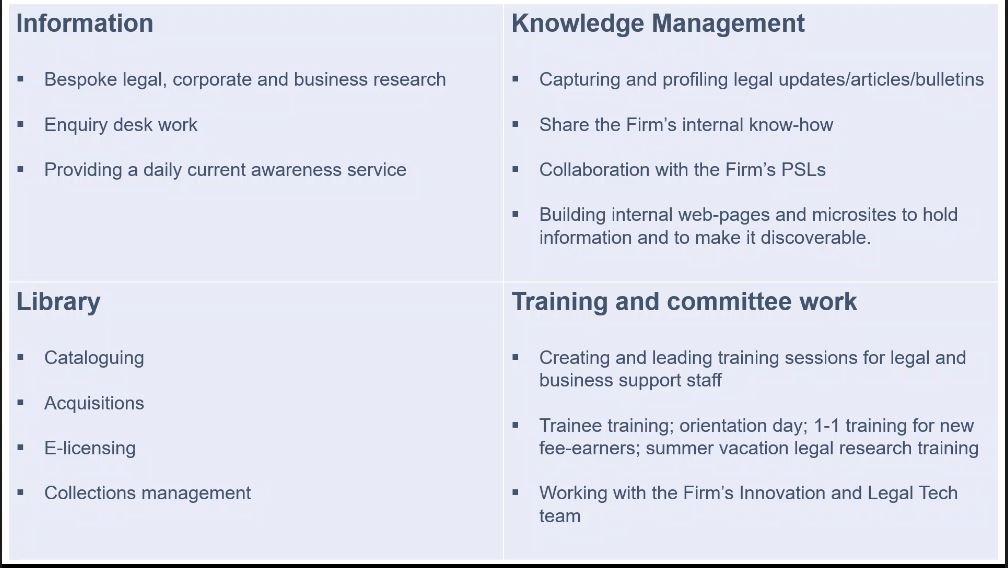
Jake began by talking about his career path and identified the tasks and roles in his current job at an international London law firm:

Graphical user interface, text, application, email

Description automatically generated


The term artificial intelligence was coined by John McCarthy in 1955 for a conference. Jake set about demystifying how artificial intelligence is being used within the legal information environment. He belives that it is necessary to ensure that the term does “not alienate the general public” through a “better understanding of the technology which it encompasses”. AI is now generally used to “refer to (sophisticated) computer software which has been programmed to automate routine tasks” and can be divided into three types:

Machine learning

Natural language processing

Knowledge Reasoning


Jake gave examples of the technologies being used such as:

  • Thomson Reuters use of natural language processing in Westlaw and the Practical Law Dynamic Tool Set.

  • software such as Kira where firms can upload contracts in batch and conduct contract analysis.

  • And the research project between Oxford University’s Law Faculty and BAILLI which provides the open access data of UK and Commonwealth judgments.


The USA seem to be more ahead of the UK with the use of AI and there are more published case studies, one example being the Case Access Project. It was a Harvard University Project which is open access, now holding over 6 million cases. The law librarians at Harvard were key players on the project which demonstrates that there is a place for us in the field. This data was also used in the Historical Trends tool. Jake showed us an example of how it works.

There are discussions about what skills do modern workers need, such as digital literacy. This chimes with many information professionals existing skills. A UK Government strategy is due to be published later this year.

During the talk and the question and answer session ethics were touched on. Privacy and data protection (if storing and recalling previous contracts and cases) has to be considered, the bias of results – AI reproduces what it knows and doesn’t aid diversity (even just in the ranking of results) - is relevant. When we employ lawyers are we not paying for the human empathy aspect as well as their expertise – is it fair to charge a large sum if decisions made by an algorithm?

Most importantly law librarians, and librarians in general, need not be apprehensive about AI as we already have the relevant skills. Law librarians know the issues with searching, natural language processing, bias - the gaps, the problems and different results that can be obtained. 

He highlighted this excellent quote from SR Ranganathan to remind us that a library is a growing organism that works alongside the organisation it serves. We are always evolving and developing and have encompassed many new technological developments in the past.


Post contributed by Kate Faulkner, Squire Law Library, Cambridge


Wednesday, 25 August 2021

June event - Gytha Lodge discussing her career as a writer and writing for computer games and currently writing her fourth novel.


 Despite being on holiday Gytha was kind enough to give us a talk on her wide ranging career and experiences. From theatre work, to writing her own books and a range of writing for video games both large and small.


As with many people we've met through the CLG you can really tell that Gytha is someone that has been really embedded into what they wanted to go. She quit her job to go and work in the theatre full time, working in various fringes and London's Leicester Square and gaining lots of experience. But bubbling underneath was always the desire to write books.


Feeling the need to focus on writing she did the UEA Creative Writing MA and that really seems to be the place that really allowed her skills to explode with the supportive teaching and continued feedback from other writers.

Especially one of the scriptwriting tutors teaching her how to pitch an idea to agents, something that had not been working up to that point.


It turns out her synopses made no sense whatsoever. As a writer she broke down the story as plot points instead of how a "normal" person would describe a story. Which sounds very sensible but we all know how what we think can seem strange to others. And it obviously worked as after that was changed she managed to get a lot of interest from agents who wanted to want work with her.

But she knew who she wanted to work with who was an agent that she had previously met in the ladies loos at Ely Cathedral! 


Your agent needs to be your mentor, friend but also the person that can say harsh things when they need to when it comes to feedback on your book. They need to be tough as they are going to be the ones going out and trying to sell it in a really intensive market.

But in Gytha's case even with the great agent no publishers were interesting  in taking her on from the first pitch.

So her agents suggested writing the second book and pitching that one instead and the first one will be easier to sell later.


Having a child and needing to actually have  money coming in she took a step back from theatre and moved into copywriting and marketing for a translation form and then slid into writing for video games.

This was working on games that had been moved over from Japan and China and they needed someone that could write good scenes in English and that did lead into actually pitching games.

This ranged from big MMO games to smaller mobile games including one of her favourite games from when she was younger, Heroes of Might and Magic where she got to make up new stories for the characters she loved. Which must be very filling both personally and financially!


But she still needed to finish her book so took a holiday and finished it off.

And 5 years after being signed with her agent she got a contract offer on her book.


But unfortunately the amount offered would not allow her to leave her job and allow her to fulfill the dream of being a full-time writer. But the value of a good agent came out again and as Gytha was now in demand she could prod other publishers to see if anyone else would be interested.

Penguin came with an offer. That was 10 times the size of the first offer. And even then her agent thought they should be paying more for the world rights. And they did.

After 21 years of wanting a publishing contract it didn't feel real but Gytha could now write full time.


Such an amazing journey and story that was amazing to hear.


Unsurprisingly there were a lot of questions from members. People wanting to know more about how to get into writing for video games, how to get an agent (some answers being to summarise your novel in one line, get other people you trust to be honest to read your first three chapters as it's amazing what you might miss). There does seem to be a lot of people in the CLG who have something just waiting to burst out and our talks bring out the opportunity to quiz those who have made it to help them on their way.


We also found out how her main character, their background and the whole detective team came about (clue: it was a suggestion from her agent) and how she has not written the titles of any book. Yet that is!


The online events we have been having have been packed full of great information and wonderful stories. We are very lucky to have people like Gytha happy to talk to us :)


Kevin Symonds

Research Governance and Information Manager - MRC Cognition and Brain Sciences


Friday, 20 August 2021

May Event: Sara Rawlinson: Illuminating Cambridge Libraries: a 3 year photographic project on Cambridge Libraries


We all know certain Libraries around Cambridge. Maybe from working there, visiting colleagues or indeed attending CLG meetings in various locations. But when we can see into them in such amazing detail through Sara's work it really does open them up to us in so many ways.


I must say that personally I had presumed that the whole project was actually a commission from the University because of course these great photographs are both wonderful art pieces but also great adverts for various elements of Cambridge's college libraries and the University as a whole. But no. Totally based on Sara's desires to explore her skills and to really get to know Cambridge better it is a wonderful representation of the college libraries. And the views and angles of aspects of the libraries that Sara chose to give us an insight into. And that it took 3 years which shows the great dedication she has put into this.


Following the Who, What, Where, When, Why and How of the project Sara took us through her route through a variety of issues. From choices made for old or new libraries, which people she worked with or indeed around and what permissions needed to be gained. And how she could actually get the work done in all the different locations and varied equipment she had at her disposal over time.


College Libraries are a wonderful mixture of old and new (sometimes  library buildings of both types in the same college) that represent the changing times and requirements in the colleges and by extension the University itself. It also shows the real diversity of what Cambridge has to offer it's students. Some people might only see their own college Library whilst a student and they are missing out. Sara's book gives us all a great view of some of what we are missing.


I was hoping that someone would have bought me a copy of the book for my birthday but guess I will have to do it myself!

Oh I just have from Sara's Amazon page :)


When things are back to normal I will look forward to Sara's next exhibition she puts on as her work is certainly well worth seeing. More details will be on her website:https://www.sararawlinson.com/


Kevin Symonds - Committee Secretary/Research Governance and Information Manager MRC Cognition and Brain Sciences Unit