Sunday, 26 February 2023

February 2023 - "Now that's what I call Theology Librarianship" with Clemens Gresser

Wednesday 8th March - 6pm

This month we hosted an online event which was a comprehensive, interesting and at some points hilarious talk by a former colleague, Clemens Gresser.  Clemens left his most recent post as Librarian at the Divinity Faculty, University of Cambridge to become Heythorp Librarian at the London Jesuit Centre, based in Mayfair.


Now That's What I Call Theology Librarianship - Clemens Gresser

Throughout his talk Clemens interspersed 7 Pathways to Theology Librarianship – having asked colleagues how they ended up working in Theology Libraries.  This was a great idea – we are all nosy about how people got their jobs, whether they had (or needed) a subject background, and we heard through anonymised questions about those whose career in libraries was definitely heading in that direction and those who just “fell into it!”  This was a great idea to include in a talk, especially pertinent to graduate trainees and early career professionals.

The talk covered areas unfamiliar to most of the audience –the difference between Theology and Religious Studies;  the importance and proliferation of biblical commentaries, and that apocryphal texts (the Gospel of Peter is actually a thing – Gospels are not limited to the “Fab Four” Matthew, Mark, Luke & John!).  He suggested that as a subject librarian, you don’t need to know everything, you just need to know an academic with expertise in the field.

We were told about the huge volume of publications in the Biblical Studies field and the need to exercise caution and not spend all of the library budget on Biblical Studies texts – for example a whole book can be devoted to just a couple of verses of scripture.  We looked at classification schemes, some of which were conceived when religion meant Christian Theology with “Other Religions” appearing as add-ons or afterthoughts.  He illustrated this with an example from the Cambridge University Divinity Library where Islam was in a category called “None of the Above” –there was no meaningful way to browse the shelves for books on Islam.  The Classification scheme for that library was amended after 2015 to include separate classmarks for Islam, Buddhism, Hinduism etc.

We moved on to thinking about Black theology, and post-colonial theology – a timely discussion as the “user-base” of practicing Christians is increasing in Africa, Asia and Latin America, and the same time as seeing a decline in Europe and North America.

There were a good few anecdotes as well. We heard that St Jerome is recognised by the Catholic Church as the patron saint of translators, librarians, and encyclopaedists, and that he translated many biblical texts into Latin from Hebrew, Aramaic, and Greek.  We also found out there is a colouring book for librarians as well (have since Googled “Librarian Colouring book” – who knew there was such a selection on a well-known online retailer’s site!)

Clemens rounded off his talk with some photos of the Heythorp Library (which covers 4 sites, including a storage site and a site at an Oxford College) and there followed a few questions from the audience.  Many thanks to Clemens for an entertaining and informative evening.

Post contributed by Helen Snelling - Membership Secretary

December 2022 / January 2023 - Christmas Board Games Night and Twelfth Night Party at CUP

December - Christmas Board Games Night

CHRISTMAS!!!

Four things are important at this time of year, 1. food, 2. drink, 3. good company, and 4. board games!

Yes, you read that right, board games; Decembers meeting had all of these.

A buffet was provided and there was a choice of wine and soft drinks.

A few of the committee members are keen board game players and two of them have quite a collection. Diane and Kevin kindly brought a selection of board games for us to try ranging from classic games like cards and Cluedo, games that not many had heard of.

Banagrams, which is a cross between scrabble and a cross word made combined words with speed. This proved challenging after a day at work, but was very much enjoyed.

Another popular games was The Table Is Lava. This consisted of cards and meeples (wooden tokens that have the general human shape). The idea is have as many meeples standing, whilst knocking your appointments meeples off their cards and into the "Lava".

There was a lot of laughter and a great night was had by all.

Post contributed by Di Symonds

January - Twelfth Night at CUP 

The group were really pleased to be back at CUP this year for Twelfth Night. This was the first time post-Covid that we'd been able to have this event, and be back in person for it. 

CUP Bookshop kindly provided us with drinks and nibbles (YUM) plus a generous discount. 

Members were able to catch up over a mince pie or two and buy some gifts/presents for themselves. 

We're looking forward to going back next year!

Post contributed by Katherine Burchell - Social Media Editor

November 2022 - Jo Browning Wroe, author of A Terrible Kindness

Jo Browning Wroe, author of A Terrible Kindness, in conversation with Helen Snelling for the Cambridge Library Group, November 30th 2022, at Lucy Cavendish College.

When I first heard about this book, my initial response was to say it didn’t sound like my sort of book, a story about a young embalmer and the Aberfan disaster in 1966 which killed 144 people, mostly children. But I thought I should try and read it before the meeting, and my expectations were totally overturned. I literally couldn’t put it down, and read it in one sitting, it is the best book by a debut novelist I’ve ever read, and I loved her spare prose style. So the opportunity to hear the author speak about how she wrote it was very welcome. The book covers a 17 year period, beginning in 1966, then going back to William’s childhood as a chorister in a Cambridge chapel choir, and then moving on to the early 1970s to show how his experience at Aberfan had left him with PTSD, and how returning to Cambridge and facing up to issues from the past helped heal him.

Jo Browning Wroe (author of A Terrible Kindness, left) with Helen Snelling (Membership Secretary, right)

Jo’s unusual childhood, growing up in a crematorium, was the springboard for the story, as she was looking up some conference papers at the UL that her father had given, when she found references to volunteers from the undertaking profession coming from all over the country to help after the disaster. Although only part of the book actually takes place in Aberfan, obviously the storyline would have to be handled very sensitively as there are many still alive who were affected by it. She interviewed some of the embalmers who volunteered at the time, and also showed what she wrote to survivors and Aberfan natives to gauge their reaction.

She began writing the book in the UL tea room, until lockdown forced her to work at home, and later in cafes. Asked about her working methods, she said she generally tried to write about 1,000 words a day, with half her time editing the previous day’s writing. She wrote the book in sections, taking time in between to mull over them before starting the next. Editing was a lengthy process, and she and her agent spent six months working on it before sending it out to publishers. It was immediately accepted by Faber, who she couldn’t praise highly enough for how they have promoted the book, and it has been one of their best-selling books this year. She was given training in all the marketing and publicity events which are now part of an author’s life, although her teaching career was a help for that. She attended 9 literary festivals in 2022, involving lots of traveling, as well as appearing on Front Row, and doing social media. She also was involved in cover design, had a say in the choice of reader for the audio version, and will have editorial control and a degree of input over casting in the forthcoming tv adaptation. The book has already been translated into a number of languages, and she had some amusing anecdotes of issues the translators struggled with. Asked about her next book, she only revealed that it is set in a 6 week period in 1973, so won’t need a timeline to keep track of things with the flashback format of A Terrible Kindness.

Post contributed by Sarah Preston, Treasurer, Cambridge Library Group

October 2022 - Cherry Hinton road with Mary Burgess

In October we held our AGM for members at Cambridge Central Library, once the minutes/AGM had finished we welcome Mary Burgess, from the Local History Collection to give us a talk about her latest book on Cherry Hinton Road.

The talk today was a walk down Cherry Hinton Road. Mary Burgess brought the road to life starting at the old Ford garage top of the road off Hills Road meandering road a leisurely pace talking about the avenues and why there are some roads with trees and the history of these side roads, without wandering too far down them.

She told us about how much the road has changed and the various shops that lined the road and her memories of growing up down the road, from butchers, and groceries and bakers. We learnt how there were different butchers selling different meats. A world away from Tesco!

As we travelled further down the road, we saw the transition from the Victorian bikes to the hustle and bustle, okay, nose to tail cars, of today.

As we crossed the road at the top of Cherry Hinton Road we then headed back towards Hills Road, coming forward in time to the Second World War. This was an emotional journey for me, as my Nan lived off Cherry Hinton Road during the war years and had an Anderson Shelter; but most poignantly for me was the story of the house on the corner being bombed and the bath hanging out! Lo and behold, Mary had a picture of this house, and there it was, the bath. Precariously hanging from the upstairs bathroom. A solemn reminder that not even Cambridge escaped the War.

She wrapped up the talk by houses that had been rebuilt and why Cherry Hinton Road has different style buildings as some are much older than others as a result of expansion and the effects of the War.

The floor was then opened to questions, and an opportunity to by her books.

The talk was really interesting and I thoroughly enjoyed my journey down Cherry Hinton Road.

Post contributed by Di Symonds

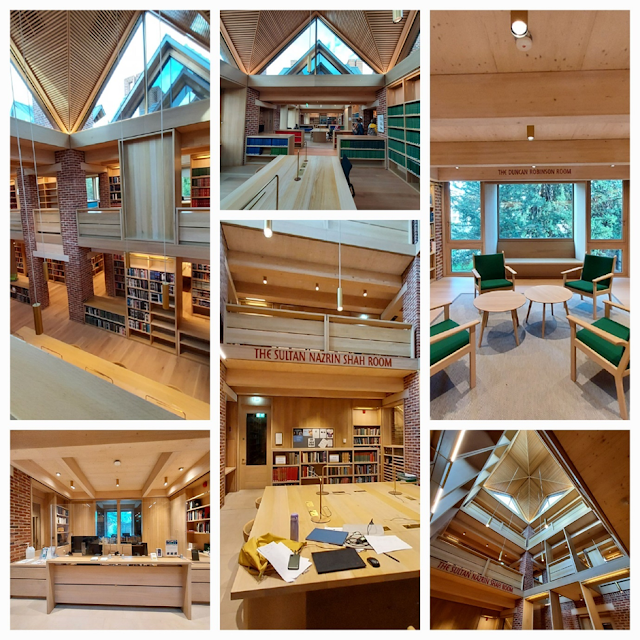
September 2022 - Visit to the New Library, Magdalene College, Cambridge

On 8th September 2022, 9 members of CLG went on a tour of the New Library, Magdalene College, which has been awarded the RIBA Stirling Prize for 2022.  Thanks to Lauran Richards for giving up her evening to show us around – you can learn more about it here: RIBA Architecture Stirling Prize Winner 2022.  Also thanks to Catherine Sutherland for her enlightening talk and for showing us around the historic Pepys Library.


Picture credits: Helen Snelling.


March 2022 - Decolonisation in Librarianship: shared experiences

Decolonising in Librarianship: shared experiences. Online 14th March 2022.


The Cambridge Library Group met online for a session of four short talks on how various libraries are tackling the issues of decolonisation.


Helen Snelling, Music Collections Supervisor, Pendlebury Library of Music, talked about decolonising the Music Tripos and expanding the library's acquisition policy, the involvement of the Faculty of Music’s Director of Performance.  This ultimately led to a number of performances of works featuring black female composers at the West Road Concert Hall, Faculty of Music.


Frankie Marsh, Assistant Librarian, Department of Plant Sciences and Cory & Herbarium Libraries, discussing her MA dissertation on academics' perceptions of critical information literacy and its role in libraries' decolonisation efforts


Sarah Hammond, Library Assistant, Squire Law Library, talking about the Squire's in-house classification scheme and decolonisation, in particular addressing outdated terminology.


Genny Grim, Librarian, Pembroke College, on the Decolonizing History project at Pembroke College Library – a focused project around the classification of history in the college library.


The evening concluded with a stimulating discussion followed by a Q&A session.

Post contributed by Helen Snelling, Pendlebury Library.

Monday, 29 August 2022

May 2022 - OxCam event

On 12th May, following the success of the previous year’s trainee talk, CLG hosted its own ‘Varsity’ special: a selection of the Cambridge and Oxford library trainees had the opportunity to talk about the projects they've been focusing on this year. We'll let the trainees report back on their projects, in their own words!


Katherine Knight, Newnham College

“I spoke about my efforts to involve the library in both college and university-wide access projects – from being involved with the early stages of the Unlocking Libraries project, to reintroducing school group tours to our college library, and finally running critical reading workshops with groups of KS4 and 5 students (including them reading a scholarly article on Pokémon Go!) Whether it’s learning how to do Harvard referencing properly so I can tell over 100 students on Zoom, or working out how not to appear on a student’s TikTok, this project has often been a challenge but never unrewarding! I find that access and outreach is so important to ongoing information literacy, as it prepares students to make the most of library resources when they reach university, and I’d encourage all libraries to look at how they can build it into their routine work.

Cambridge Library Group have been such a fantastic resource for me in my traineeship: having started during Covid, they were a wonderful way of exploring different kinds of librarianship in lieu of the usual library trips, and I have very much enjoyed being on the committee this year. It was a pleasure to speak for the Cambridge Library Group again and I look forward to seeing how they continue to support library trainees in the future!”


Ellen Woolf, Anglia Ruskin University

“I am very grateful to CLG for inviting me to speak at the Cambridge and Oxford Graduate Trainee Talk, as it was a great opportunity to showcase the Graduate Traineeship and the benefits it can have for both trainees and libraries alike. The Graduate Trainee at ARU has quite a different experience to one at an Oxford or Cambridge college library, so it is really interesting to meet one another and have these discussions. While every traineeship is alike in structure, training, and visits, it seems that every trainee has a totally unique experience. This speaks to the diversity of different academic libraries and illustrates very well that there is no one way to run a successful library.

I discussed how the Graduate Trainee slots into the staffing structure at ARU, the different working groups and projects I’ve been able to participate in, and the experience of working on the Cambridge Graduate Trainee website, CaTaLOG. I reflected on what I’ve learned so far, and looked ahead to what’s next after the traineeship ends. Being a Graduate Trainee has been a truly wonderful opportunity to learn about library work, and it has given me an exciting and inspiring start to my career.”


Heather Barr, St Edmund’s Hall

“I was delighted to join the Cambridge Library Group as a speaker at their Graduate Trainee Talk. Joining forces from Oxford with the Cambridge trainees has been a real highlight of my year, and I hope it’s something that continues in the future! My talk focused on my Library sustainability project: Going Green Together. This aimed to reduce the St Edmund Hall Library’s impact on the environment, and to encourage sustainable practices across our readers and staff. From weighing the bins to work out the percentage of our waste which is recycled, to waving my hands at the bathroom lights’ motion sensors to work out how long they are staying on, I am sure I communicated just how… glamorous this project has been! It has certainly been very rewarding, however. For example, messaging and tips to reduce printing succeeded in reducing the amount of paper used over 90 days by over 1600 pages! Speaking at CLG was an excellent opportunity to learn about others’ trainee experiences, and what really stood out for me was the breadth of what librarianship can look like. Even though we all work in academic settings, providing a service to a similar demographic of students, hearing from Ellen, Katherine, and Georgie highlighted just how varied this work can be, and I’m greatly looking forward to continuing to share and learn from innovative ways of interacting with collections and readers.”


Georgina Moore, St John’s College

"How do you make a digital edition?  For my Graduate Trainee project, I learnt to transcribe, edit, and encode a digital edition of one of St John’s College Library’s most popular Special Collections items: a collection of letters by Jane Austen. Even if you have no coding experience (I didn’t before I started), using the free and accessible 8 part training course created by Emma Huber at Oxford’s Taylor Institution Library, you really can make your own digital edition. In my talk I stressed that this project developed not only my digital but also my palaeographic skills, allowed me to get to know the collection better, and was a genuinely fun trial and error challenge! Also, Austen is hilarious in her correspondence, so I certainly got a few laughs out of her anger towards Walter Scott who “has no business to write novels, especially good ones. It is not fair.” If you would like to try it for yourself, start the training at https://editions.mml.ox.ac.uk/training/. "


Friday, 10 June 2022

January Event - An Introduction to Radical Open Access Publishing

As someone for whom Open Access is the core of my job I was greatly looking forwards to Sam’s talk and it did not disappoint.

Looking at his background in publishing gives you a nice insight into Sam’s progression from being an editorial assistant at PLOS all the way to Open Book publishers and humanities into launching the Radical Open Access Collective and his academic work with his PhD in Digital Humanities at Kings College London (https://hcommons.org/deposits/item/hc:24135/And it is the different viewpoint of the humanities instead of the STEM focus I have in my work that was happily very well explored in this talk.


Sam works in the OSC as a Scholarly Communication Specialist supporting researchers with open access publishing but on a basis that is slightly different than mine. The MRC CBU is funded by the UKRI with it’s mandated OA policies. Sam works on the wider university basis on why they should be doing it instead of just having to and that is one thing I really wanted to know about.


This also ties in wonderfully with the work of the Radial Open Access collective, a group of small publishers, getting together and working on funding, organisation, advocacy and progression through publishing for publishing, not because you have to do things a certain way.


Bringing people together to help with the under-represented parts of community. It is the northern hemisphere, well-funded governmental bodies and organisations that are setting policy to force us one way and the large publishers are making the most of that change over time.


It does indeed need to be much more scholarly-led not policy led which I totally agree has led us from one form of issue to another, but with higher bills and less choice and freedom for our researchers. And it will only progress further. If UKRI policy is to continue on it’s intended route then all publishers will be Gold OA. With the inherent costs involved in funding that. When I’ve asked what happens at that point I was told then they will work on changing things when they get there.


We need to change things now. And the Radial Open Collective isn’t the one going to be doing that for us, but it is the right mindset at the right time to make changes and has the ideals of how to get people involved in publishing for publishing’s sake, for change in the way researchers work and publish and even get people to actually consider the ethics underpinning their work. From the choices of where you publish, to the totally free editorial and review work that thousands of people in Cambridge do for free on a regular basis. These are things that need to be addressed and tit was really nice to see this being explained and expanded on in this talk.


And I look forward to seeing more of these issues being addressed in projects such as the new Rights Retention policy that the University has recently started.


Post contributed by Kevin Symonds, Research Governance and Information Manager, Cambridge University

Friday, 27 May 2022

April event - Bansa Community Library

April’s CLG event was the first to feature speakers presenting from across continents. It was an inspiring evening, as Jatin Lalit Singh, Founder of Bansa Community Library & Resource Centre, based in Bansa and New Delhi, and Abhishek Vyas, MPhil Education student at Cambridge University and the Community Library’s Academic Coordinator told the story of Bansa’s genesis and evolution.

Both presenters had backgrounds in law, and it was while Jatin was studying law in Delhi that he came across the Free libraries network with its concept of community libraries, and wondered if this might be something that could work in his own home in Bansa, a village about the size of Soham, in rural Uttar Pradesh. Jatin was aware that his own privileged background had given him a level of access to a range of educational resources especially books, but what about the many in India for whom this was just not possible? Could a community library make a difference? The subject was eagerly discussed online by a group of Jatin’s friends, all of whom were law students, but none of whom had met in person.

Across the road from Jatin's home in Bansa was a temple. Jatin reasoned that as temples have large grounds, there might be room for a small library. The temple authorities and village elders were approached with tentative plans, and these were enthusiastically received. The temple leased out the land for a peppercorn rent, and then Abhishek and Jatin started to fundraise. They were not able to get government funding but interested parties contributed to what they saw as a worthwhile and exciting cause. 

An architect friend designed the building and gave it its bright colours. 


Bansa Community Library


Soon shelves were up, and books swiftly arrived to populate them. Volunteers reached out to communities, talking to them about the new resource that was shortly to be available; alongside this, colourful wall paintings (in the same colour as the library buildings) sprang up advertising the library. The publicity was needed, as there was initially some confusion. Villagers wondered if the new building was a kindergarten. Or perhaps it was a school, or a community centre? In truth it was a mixture of everything, but this made advertising and promotion tricky – the Bansa team wondered who exactly were going to be their readers.

Their very first reader, who arrived the day before the official opening, inspired them to a realisation that their readers were everyone. Mr. Mahendra was a 63-year-old man, who was absolutely delighted to discover that there were books available for free, and he soon spread the word excitedly around the village about the new library. As Jatin commented after meeting Mr. Mahendra: “we [knew we] needn’t worry if people would come and read because there was no reading culture, [or] because they didn’t know the concept of community libraries, but that day seeing the zeal and enthusiasm of Mr. Mahendra we were convinced that ultimately readers would find the books if they were there to be found, and the library was open.”


Mr Mahendra with books

Resources grew, a computer was added to the library’s stock, along with books in numerous Indian languages and dialects, and from further afield too (Dan Brown and Harry Potter both proved popular). Alongside this, classes were started for students preparing for state exams. A conscious decision was made not to promote the building specifically as a library as people had so many, often quite different, ideas of what a library should be. Indeed, Abhishek had been adamant from the beginning that the library should be seen as a resource centre, and this was included in its name; ready to serve, change, and adapt to the needs of the 36 villages that would use its services. For some, the building would be a library and a school, for others a community centre. Dance and music classes, alongside a range of talks were started, and locals of all ages took part in activities there from young children to the elderly. 

Bansa Community Library classes

Children were encouraged to visit the building on the days when new books arrived and took a huge delight in seeing and handling them. Determined to make the community library as inclusive as possible it was decided that there would be no fines. For many even the possibility of a small fine would discourage them from using the space and its many resources, so as a people’s library it is truly open to all with no fines, fees, or subscriptions. Anyone, of any age, can come in, give their name which is jotted down in a book, and can then borrow or use any of the facilities for free. Alongside their work in promoting education the staff of Bansa Community Library also promoted the largely unknown concept to rural India of reading for pleasure.

The library was already offering a range of services across its communities but when India was hard hit by a brutal second wave of Covid, Bansa Community Library and Resource Centre became a vital community hub. 

In common with many community buildings worldwide, the library became a Covid testing centre, but Jatin knew that people were dying in the Bansa area sometimes because of a lack of medical resources, other times simply because they lacked knowledge about the disease, so the team decided to start its Rural Covid Relief Work, and this would lead the library to become a focal point in the battle against Covid. Alongside Covid testing, it stocked free medicines and medical equipment – everything from thermometers to hand cleanser and masks, with volunteer staff on hand who could race out to those who were ill, with blood pressure monitoring equipment or oxygen level monitors. They also organized vaccine registration, and even provided transport in exceptional circumstances. Staff were kitted out with bright yellow t-shirts, to match the glorious yellow walls of much of the library, and these t-shirts became a sign of hope in the rural communities of Uttar Pradesh.

Abhishek’s insistence on calling the library a resource centre might have seemed odd at first, but suddenly it made sense. Yes, this was a library, but it was also a place where you could borrow sports equipment or toys, learn to play a musical instrument, or study for exams; a place where children could look at picture books, or where you could find a friendly face with an oxygen monitor for your father. 

Since then, the Community Library has made huge strides. Children love the building, and a student council has been established who give regular ideas for how they would like the library to be run, and what projects might be useful going forward. This has been immensely important in engaging them with the work of the library, and in improving their self-confidence, and sense of self, and they have become a vitally important part of the day-to-day running of the library. Classes are run regularly to offer advice on homework, and to provide remedial classes for children who are struggling with specific subjects. Peer to peer learning is also encouraged and has proved extremely popular. Law students and young lawyers volunteer to give talks on basic points of law, and to make everyone aware of their rights and how the law works. 

A large LED screen was recently added to resources, and this has meant that virtual classes for all ages can now be held online with volunteer teachers from across the country talking about a range of subjects for all ages and abilities. Earlier this year a Cambridge PhD student talked about STEM subjects to a large and enthusiastic audience. The LED screen has also been used in a recent popular venture - film nights - to which all are invited (Home Alone opened the film season).

As the range of activities increased, some dedicated staff were needed and Bansa Community Library and Resource Centre now has a manager to manage all the activities, and the two librarians who are employed there. A female librarian has been employed as the library has become increasingly popular among female readers and students, who find the community library a safe place to work. Its growing popularity has also meant that it is rapidly outgrowing its current two rooms, and there are plans to ask for land to provide a third. 

It was an inspiring talk about an amazing project, and I think we all left feeling proud to know what a difference a library can make, and energized by the enthusiasm of the young team who started and continue to run this incredible project. 

The young people of the Student Council have put together a YouTube video touring the Community Library. It gives you a real flavour of the joy that is Bansa Community Library and Resource Centre. Do turn on closed captions when you play the video, and change language of settings to Hindi, to make optimal use of the English subtitles.
Bansa Community Library Welcome Tour by Student Leadership Council

You can also follow the team on Twitter @BansaLibrary

All photos are courtesy of Jatin Lalit Singh and Abhishek Vyas, with many thanks for their help. 

Post contributed by

Margaret Jones


Thursday, 26 May 2022

February event - Ellen Krajewski - CILIP Carnegie medal and judges experience

CILIP Carnegie medal and judges experiences

Many thanks to Ellen Krajewski who presented so enthusiastically on the CILIP Carnegie Medal and Judge’s Experience. She has been a judge three times for the prestigious Carnegie Medal and Kate Greenaway Medal and had a year as Chair of Judges. Ellen has always had a passion for books and retired in 2019 after being a School Librarian for many years. All 14 judges on the panel are librarians and members of CILIP. In addition they are all required to join YLG. Each area of the UK is represented by a judge and there is a CKG Working Party which is the strategic power behind the Medals.


Ellen covered the awards’ cycle and went into detail about which published books are eligible for entry. Publishers have no say in the nominations which are put forward by CILIP members. The Diversity Review took place and resulted in positive changes showing how the awards can champion diversity. 


For the past three years there has been a Shadowers’ Choice Award, voted for by the large number of Shadowing Groups who all read the shortlisted books. Some of the groups are based abroad and they tend to be from public libraries and schools. Ellen described the various types of meetings the groups hold and members of the CLG were keen to start their own shadowing group as soon as the shortlist is confirmed.


The new name of the Yoto Carnegie Greenaway Awards reflects the new partnership with the innovative digital company which secures the future of the award. Winners will be announced on 16 June and hopefully this year the presentations will take place in person as well as being live streamed. Ellen rounded off her comprehensive talk by picking out some of her favourite winners and shortlisted books, including books in verse.


Links:

CILIP Carnegie Awards: https://carnegiegreenaway.org.uk/